
Both La Dolce Vita and Breathless were released in 1960, becoming staples of European art house cinema and must-sees if you have to acquire a Cinephile card. One was made by a former critic announcing himself as a major voice, while Fellini was already a great director before making this film. But this was the first of his films to acquire a cult of personality, often ranking very high in greatest films lists. But sometimes it becomes difficult to separate the film from all the critical bravura surrounding it. My first time watching this film, I didn’t think about it during the film per se, but when it came to writing about it I kept thinking back to all the critical writings about the film, questioning whether to review the film for what it is or try to argue about the different interpretations devised by cinephiles since the film first came out.
On the surface Marcello (Marcello Mastroianni) seems to have the ideal life, especially seeming for a small-town kid like me. Peel back the layers, however (which is what the film does) and his concerns are strikingly similar, an inability to finish a book, doing a job he hates etc. Mastroianni is fantastic in the role. He’s smouldering and handsome enough that you have no problem believing that all these women are attracted to him. But his face also hints at the turmoil underneath. The film unfolds in segments, at times comic at times tragic, sometimes both. Fellini takes great pleasure in satirising the media, pulling stories from the Italy of those times, such as the children seeing Madonna. We are introduced to an assortment of women who are film stars, painters, rich nobility who egg him on, drawing him closer, but just as easily push him away. And then there’s Emma (Yvonne Furneaux) who is head-over-heels in love with him, but mostly what they do is fight, because of his refusal to commit. There’s also Steiner (Alain Cuny) a man greatly admired by Marcello, for everything he himself desired. Steiner proves the catalyst for the Marcello we see in the last episode, given up on both life and his career. This is another opportunity for Fellini to take a dig at the media and there is a very funny conversation about what Marcello is willing to write about his client in exchange for money. There’s also a earlier scene too with Steiner’s wife that is darkly funny. One of the lasting images from this film is the photographers scrambling all over themselves to snatch photos of the most minor things.
Fellini started out with making neo-realist films like everyone in Italy at the time until he slowly transformed into the man who made Satyricon ( the first Fellini I saw, perhaps not such a wise choice). Vita is a necessary stepping stone in that direction. Nights of Cabiria remains my favourite Fellini film, but each film I see just confirms the fact that Fellini is one of the greats.
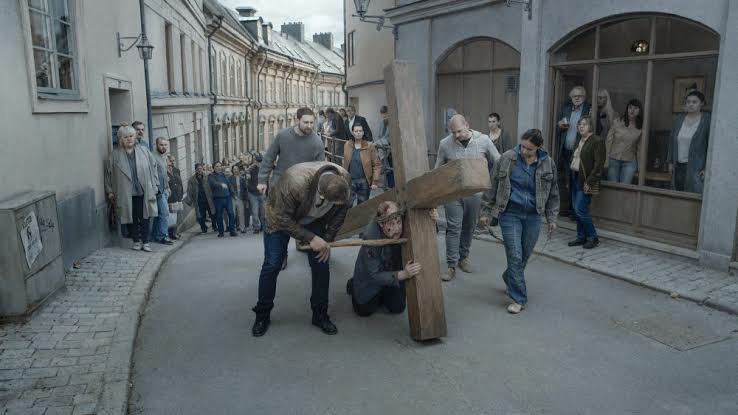
An unmoving camera, drab colours, already quite pale actors in white makeup looking gaunt talking in a self-pitying voice. Yep, we are in a Roy Andersson film alright. About Endlessness is more political and more cryptic than his so-called Living trilogy ( I say so-called because Endlessness fits right in to make it a quartet) but also less funnier, by design.
Like in the Living trilogy, the film consists of short vignettes centered around a main storyline. And it’s a terrific central story, about a priest who is losing his faith, and the shrink he visits. The priest has nightmares of being dragged across the street by faithful Christians and this being a Roy Andersson, the onlookers just stand by. If the central storyline wasn’t enough of a political statement itself, there’s also a scene concerning Hilter. The female narrator introduces the scene as ” I saw a man who wanted to conquer the world and realised he would fail. ” The Hilter here looks exactly like you would imagine a Roy Andersson Hilter would look like. His drunk commanders give a half-hearted heil, Andersson perhaps summing up what he thinks of the war in two minutes flat.
The film is scant, clocking in at 78 minutes with credits. Perhaps that’s why it didn’t hit me as hard as A Pigeon. And as I said earlier it’s not ha-ha funny like sometimes the Living trilogy was while still being tragic and making us empathize with the characters. In fact, in this film Andersson is sometimes content with just setting up scenes with narration and letting them run without dialogue. Still, Endlessness is a singular feature that could only be made by Roy Andersson and it’s worth seeing.
 Alvel's blog