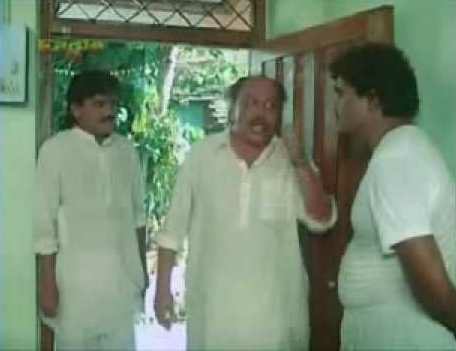
I can’t remember having not watched Ashi hi Banwa Banwi. It is on TV constantly and is quoted endlessly. It is what one would call a ‘touchstone film’. A film filled with gags that have stood the test of time and paradoxically, actually sometimes get funnier the more you watch them. There are a few factors at play as to not only why the film seems timeless but also why it has burrowed itself in people’s mind the way few other commercial comedies of that period have.
First, there’s the plot. Adapted from Hrishikesh Mukherjee’s Biwi aur Makan, the plot has the Mukherjee-ian touch where the protagonists trick people, who are usually elders who won’t let go of preconceived notions. A Mukherjee protagonist though isn’t malicious or devious, and he does what he does out of sheer desperation. In Banwa Banwi too our protagonists are desperate after being evicted from their rented home by the owner (Sudhir Joshi, sometimes naive, sometimes cruel, a classic foil). This housing crisis leads them to the door of Lilabai Kalbhor (Nayantara) . The house is nice but there’s one caveat: Lilabai only allows couples to rent her house. Lilabai is half-blind with one lens of her glasses cloudy. This represents her duality. Owner of a nice house but which can only be occupied by deceiving, nice and motherly by nature but will also eavesdrop on your conversation. So, it is the four protagonists (Ashok Saraf, Laxmikant Berde, Siddharth Ray and director Sachin Pilgaonkar) decide to pose as couples (this realization is preceded by another witty scene involving Bal Gandharava, famous for playing women on the stage, and to whom the film is a tribute to) with the characters played by Berde and Pilgaonkar donning makeup and dressing in saris.
What really makes this film is the acting. None of the actors are out of their comfort range as such as they riff on their own star persona (except Ray). Saraf plays the straight man mostly albeit one who isn’t afraid to get a sly dig in. His one-two with Sudhir Joshi is the stuff of legend. But the film really belongs to Berde (affectionately known as Lakshya). He was perhaps the greatest comic of the Marathi screen, combining the lewdness of Dada Kondke with a small-town naivety that was entirely his own. He was the flabbergasted youth, in service to the whims of his seniors and sometimes his lovers. His character, at first obviously reluctant to don the sari, gets comfortable with it as the film progresses and we also see Lakshya himself relishing this part. Almost every scene involving him is a winner especially when he is in disguise. Another thing to note is neither the film nor the characters do anything to condescend the women, even though they are only pretending. They sometimes actually get a test of what it is like to be a woman, like when Lakshya has to ward off advances from leering men. I don’t know how much how much of it is down to Pilgaonkar’s directorial touch and how much to the performers themselves but the gender-swapping never comes across as dated.
Oh, and did I mention there are also romantic counterparts for our heroes, played by Nivedita Joshi, Supriya Pilgaonkar, Ashwini Bhave and Priya Arun? None of these women, with the possible exception of Bahve really have much to do. But that maybe because the film’s made-up women are so interesting it hasn’t any time left for the real women. They exist mostly to provide for a few songs and appear only when the plot needs them to (again with the possible exception of Bhave). Nonetheless, that doesn’t detract from the film being an absolute knockout of a commercial film.
Addendum: This piece was partly inspired by a viewing of the fim during the lockdown, but also by the lack of Marathi film criticism on the Web. What gives?
 Alvel's blog