The reason that Zenda may appeal to any Indian person no matter if their political leanings are different from those of the director (for I suspect director Avdhoot Gupte to be some sort of Hindu Nationalist, if not an outright one) is that it comes to the same conclusions that almost every Indian man of a certain age has come to; that Indian politics is beyond repair, sunk under the weight of corruption and shifty politicians out to fulfill their own agendas and that the facade of welfare of the Indian peoples to be a very attractive but empty promise. This attitude might be considered defeatist were we not aware (too aware) of the situation in Maharashtra (and by extension India) and if politics wasn’t in a state of such stagnation.
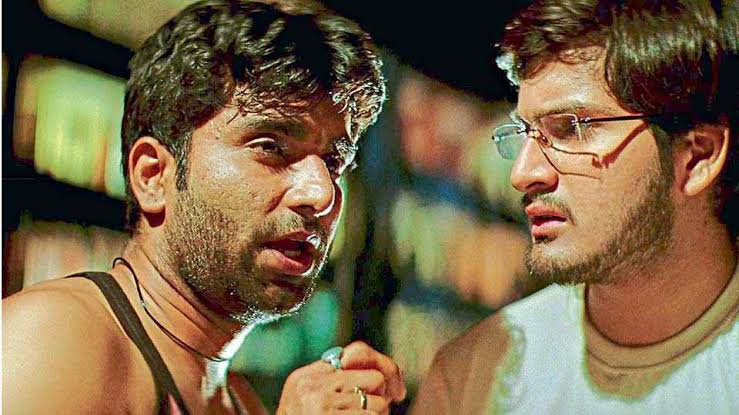
Zenda changes names but it would be clear to any Marathi person that this story is about the Thackerays with a sideways dig at Narayan Rane. Inspired by the real life fracturing of Shiv Sena (Jan Sena in the film) into two after the shunning of Raj Thackeray in favour of Udhav by Balasaheb, the character inspired by Raj, Rajesh Sarpotdar (played by Rajesh Shringarpure) is incredibly accurately portrayed, not only in terms of the acting but also in turn of his flip-flopping for want of political power. Being a Hindu nationalist himself, Gupte’s critic of the movement is different from other left-leaning sources. Because he believes in the message, he illustrates how the party leaders fail believers like him by way of two characters Santya (Santosh Juvekar) and Umesh (Siddharth Chandekar). The latter thinks with the forming of the Maharashtra Samrajya Sena (film stand-in for the Maharashtra Navanirmaan Sena) his ideals will finally be matched by the party leader and he will finally be witness to the glorious ‘Hindu Rashtra’ of Saavarakar. The former however remains committed to the Jan Sena. Both of them, no matter what they do are bound to get betrayed by their party. They talk among themselves of betrayal and fidelity, but don’t seem to realise it is their political leaders who are the infidels.
Umesh changes allegiance to go with Rajesh Sarpotdar but quickly realises this is no promised land. His objections start with the flag, when the leader decides to incorporate the green colour (the Muslim colour) into the flag. His objections reach a crescendo with the most repulsive scene in the film. In his want of votes, Rajesh strikes up an alliance with a Muslim leader. This Muslim leader is equated in his personal actions with that of a Jihadi leader (Gupte not being the first or last to do this) and he orders Umesh to hold his spittoon for him, spitting into it with some of it landing on Umesh’s hand. Then Gupte places a montage of Umesh trying to get the sting, the shame, the stench of that off his hand, washing his hands repeatedly, it somehow being implied as if he wouldn’t have felt such shame if a Hindu had spit on his hand. On the one hand (no pun intended) this is as I said a very repulsive scene Islamophobia and Hindutva in all it’s inglorious glory. But on the other hand it is a powerful depiction of the whore-ness of our politics leaders even if it is problematic in execution.
As for the directing itself, for a first time director who is mainly a musician it is not bad, though nothing compliment-worthy either. Sometimes Gupte irritatingly starts off exterior shots with zoomed out ratios but this is a minor complaint, the rest of the film using standard angles and shots. Nothing to imply Gupte is out of his depth.
It is almost pointless to say Zenda has aged well since it is a film about politics done reasonably well and politics doesn’t change much , at least not in the span of ten-odd years. But it is instructive to see the film in light of the 2019 Vidhansabha elections in Maharashtra as well as the political trajectory of Raj Thackeray. First, Raj Thackeray who as depicted in the film seems to change alliances on a whim depending on what can get him the most votes or, let’s face it, what can keep him in the limelight and relevant for since an initial hopeful campaign in 2009 and a victory in the Nashik municipal elections his importance has trailed off. His party lost Nashik just as quickly as it had gained it and newspapers just use his quotes nowadays as click bait (print bait?). Is he supporting or against Modi right now? I couldn’t tell you and whatever the answer is right now I am sure it would be different in six months. But that’s just the political side of him, but what the film excels at in depicting his character is the deep-lying insecurity masked by the hard exterior. In one of his first scenes we see him humiliate and mentally abuse a North Indian servant of his and he impresses his audience with the sheer forcefulness of his personality. But the exterior cracks and you see the frail man hungry for some, any power. Umesh’s growing impatience at him represents the people, his core voting block losing faith in him. In these scenes he is like a little child or a hapless man pleading with Umesh to have confidence in him ,that nothing’s changed, he will realise all their faith in him and deliver all their promises. Similarly, the real Raj Thackeray for all his so-called hard-hitting and blistering speeches is mostly content with going after Bollywood celebrities, asking for the removing of Pakistani actors from films, choosing something this irrelevant because he knows that’s the only way nowadays he can stay in the headlines.
If Zenda wasn’t prescient enough to predict the rise of the BJP (it’s focus is squarely on the Thackerays and party members) it does reinforce the fact that even with this new force in Maharashtrian politics things remain much the same. In the chaotic aftermath of the Vidhansabha elections in 2019 as the media reported feverishly on every development and every meeting and every possible alliance and every accusation and every interview with a lower level leader it was clear that nobody was in the right. The swinging of Ajit Pawar from first BJP to Shiv Sena and Congress, forced us to remind ourselves how much we are in the dark about the inner workings of the traditional leaders and families that seem to decide the future of the state without once caring for the man on the street. It also confirmed that there is no ‘major’ left-leaning political party in Maharashtra. To be fair there are no leftists in Zenda either which seems like an accurate representation of the political landscape in Maharashtra.
In summary, Zenda despite being Hindu-nationalist aligned should be seen for it’s quality of parody and the helplessness it shares with the common man about politics.
 Alvel's blog