Splitsville
Despite boasting Dakota Johnson and Adria Arjona in its star cast (they also serves as producers), Splitsville barely made a mark in the cultural consciousness. With Neon’s busy slate, it is not a surprise, but it’s a damn shame because this is a damn great film.
Right from the off, the film establishes its raunchy and joke-a-second tone. A couple (played by co-writer Kyle Marvin and Arjona) struggle through the logistics of having sex in a car, while another car on the road careens off, leading to a woman in the car dying. That’s just the start though as every time you think the sequence has reached its high point, it just builds and builds, throwing one punchline after another.
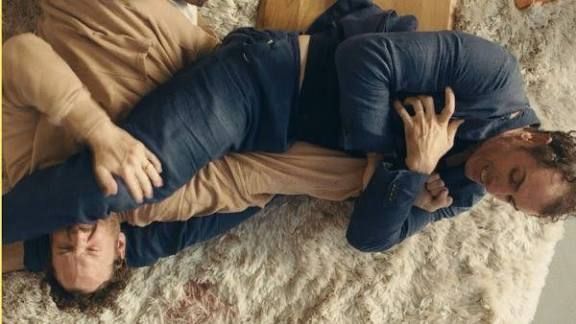
That’s a feature of this film, where every situation is milked for its comic potential. The plot is somewhat sitcom-ish but it’s elevated by gags that, while exposing the inner frailty of the characters (they are all marred by one of the key jealousies of our tines, the knowledgethat your partner is sleeping with someone else), keeps its foot on the pedal and doesn’t let the joke to time ratio slag. Take for instance the fight between best friends Paul (director and co-writer Michael Angelo Covino) and Carey (the aforementioned Marvin). It involves pro wrestling submission moves, a drowning attempt, and a mid-fight rescue operation for fish.
At its core, Splitsville is about characters who are less progressive than they think they are. They are out to fix what ain’t broke. This is especially the case for Paul, a man who is married to pretty much the dream woman, Julie (Johnson) and still insists on an open marriage. Perhaps they are in need for some experimentation and exploring (moreso Marvin and Arjona’s characters) but only to realize they have been with the right person all along.
Splitsville is a film that deftly fuses jokes about Hammurabi’s code and gaslighting men. And it is much better than Johnson’s other relationships-focused film of 2025, Materialists.
The Testament of Ann Lee
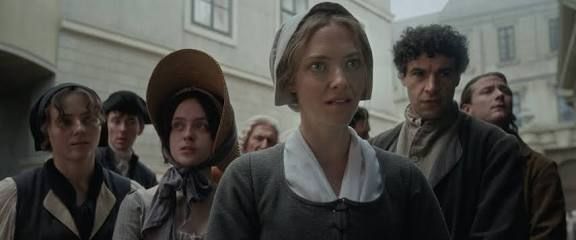
The Testament of Ann Lee is a heady mix of ambition and stellar craft that has the ability to fixitate a viewer into place. I was bolted down in my seating place, letting the rhythmic editing of the shaking sequences wash over me. I was awed by the costumes, the music, the acting, the production design, and the general sweep of the project.
And yet, the team behind Ann Lee hasn’t quite pulled it off. I found myself reminded of the The Brutalist, by the same writing team but with Brady Corbet directing instead of Mona Fastvold, a film were I was similarly impressed by the craft but felt let down by the storytelling. Both films are sure of their own greatness and while I think that’s a good thing in how sure the films feel, I wish I could partake in this perceived greatness too.
But, Ann Lee is good when it’s good. This is particularly the case in the Shakers numbers. It’s hard to think anyone amassing followers practicing strict celibacy, but the shaking sequences convince that yes, this could be something that people would want to take part in willingly. As they swirl and sing and strain, these Shakers become downright orgasmic, perhaps finding here what they cannot in sex.
The film is helped greatly by Amanda Seyfried’s performance as Ann. She is convincingly both when she is feeling helpless (a too on-the-nose scene where her husband has sex with a prostitute right in front of her is rescued by Seyfried’s acting), and when she is feeling confident (the scene on the boat). She is provided ample support by Lewis Pullman, following her sister along no matter where she heads, even if it means making life-altering sacrifices.
The film looks magnificent. The cinematography deftly captures both Revolutionary War-era US and the dilapidated state of things back home in Manchester. Even the informational slides in between scenes, and in the end credits, are done with verve.
Where the film fails is in its template-like storytelling. However, Fastvold wants to disguise it, she is directing a conventional (if not in approach then in plot) biopic. The film simply does not wade deep enough in the mires of Ann Lee’s life and movement.
See, for instance, the almost flippant way it deals with Ann Lee’s four children dying. It also doesn’t devote much time as to how Ann became a leader in her religious movement.
And yet, perhaps the biggest problem I had with the film was the narration. I kept waiting for it to take an ironic tone or perhaps have the narrator (played by Thomasin McKenzie) take a more personal inflection. Instead, it is the most unnecessary use of narration in a film I’ve seen in quiet some time. Perhaps some should be watching the Brian Cox scenes in Adaptation unironically?
Still, the stylistic flourishes and exceptional imagery make the film worth seeing. I just think it’s less than the sum of its parts.
 Alvel's blog
One thought on “Reviewing Every Independent Spirit Award Nominee (2025): Splitsville, The Testament of Ann Lee”