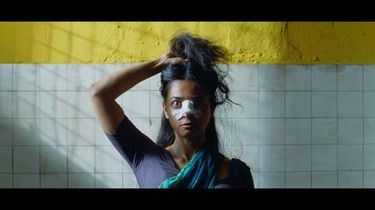
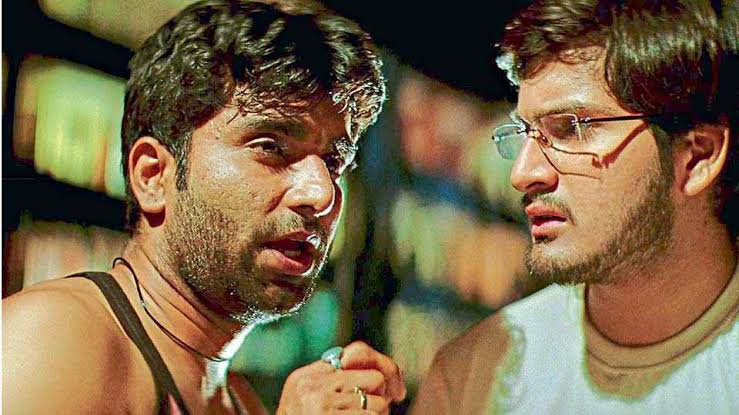
The problem I feel with any anthology film is the multiple beginnings. Once a short ends you have to start over, refocusing your priorities and if it’s directed by a different director, as it is here, you have to get in line with a different perspective. There’s a reason anthologies don’t relate to short story collections like single-story films relate to novels. That’s because, while the experience of watching the two is different the means are the same. There’s no breathing space between two shorts to let the short we have to seen to breathe, to let it assimilate again in your brain. One could argue that one story informs the other, that our perspective of the short changes due to the short preceding it but that’s only true some of the time. Other times, you end up comparing the previous entries in your brain and the subsequent shorts start with an unfair disadvantage.
That being said, The Bridges of Sarajevo is largely a triumph. It doesn’t exactly overcome the problems I mentioned above but the individual shorts themselves are well directed for the most part. I must confess to being familiar only with Jean-Luc Godard and Christi Puiu of the directors but there are good entries from directors I am less familiar with.
1) My Dear Night (Filip Todorov)
Starting off with the seminal event that would play such a huge part in Sarajevo’s history, My Dear Night concerns the night before and the shooting of Prince Franz Ferdinand. It’s not a particularly strong start and as a way of introduction it might leave you feeling the rest of the film is going to be just as bland. There’s good lensing in the night scene where Ferdinand is shot and I liked the visual of of waiters in the back just going on with their business even after the assassination. But, there’s much better things to come.
2) Our Shadows Will (Vladimir Perisic)
The focus immediately shifts to the other side with Our Shadows Will concerning the writings of Gavrilo Princip. Filmed in a non-direct style, with the narration first beginning accompanied by a black screen, Princip talks about the oppression of Yugoslav peoples under Austria-Hungary. In his call for a united Yugoslavia can unmistakably be heard the views of the modern Yugoslav nationalists, but it is filmed in such a style that shows the film is not agreeing with him just giving an insight into the mind of Princip. This is also the first indication of the more experimental shorts that are going to appear.
3) The Outpost (Leonardo Di Costanzo)
Well Costanzo clearly thinks of his film as unique because his short ends with card detailing the number of Italian victims lost in World War I. But does the film deserve it? Well, not really. It’s a pretty standard war story for the most part with an ending that does raise some questions but grappling with those questions is not within the scope here. So, both the end card and the short are a misstep.
4) Princip, Text (Angela Schanelec)
Like Perisic’s entry, this too focuses on Princip’s writing. The difference here is, while that film approached his writing through performance, this one focuses on study. Unfortunately for Schanelec, the writing chosen by Perisic is much more memorable and so in turn his film is more memorable.
5) Das Spektrum Europas (Cristi Puiu)
Das Spektrum Europas is the only one of the shorts that may make you guffaw (at least until the last one). Puiu’s trademarked sense of humour comes in handy as his segment moves away from Sarajevo and through an old couple makes comment on the various prejudices Europeans harbour about each other. Highlights include the husband saying “the American Jews are the worst of all” and a mixup between the publishing date of the book that starts the whole row between the wife and husband.
6) The Bridge of Sighs (Jean-Luc Godard)
Archival footage and still images combined with clips from his prior films, this is an archetypical Godard ‘video’. With this short starts not only the more experimental part of the anthology, but also a much better engagement with the titular city with the focus now shifting to the aftermath of The Yugoslav War and the city’s occupation. Godard waxes lyrical about culture, art, war narrating over the images showing armed officers and corpses. Again the problem of the anthology comes into play. These observations made by Godard would have made more sense if they were a experimental film of their own but here they feel smushed in.
7) Reflections (Sergei Loznitsa)
Superimposing photos of young men (and even boys) with rifles and guns over modern day happenings in Sarajevo, Reflections is a holding-of account of the youth lost during the war, not only the loss of lives but also the losing of the morality of these young men who take up arms. Shot in black-and-white, the city almost looks exotic, were it not for for the constant reminder of the faces of these soldiers looking in turn menacing, afraid, child-like and all unmistakably Balkan.
8) Zan’s Journey (Marc Recha)
Recha’s short most resembles a short story with it’s wistful narration and it’s almost nostalgic rememberance of the war. The protagonist here is from a family that was relocated in Catalonia after the war and through some engaging imagery Recha gives a feel of the people who had to face these conditions, whose survival was uncertain and whose lives were uprooted. There’s regret over the city library being destroyed and a book the father was able to save. The book is later lost just like the people after the war.
9) Album (Aida Begic)
Begic is the only one of the directors from the city and it shows. Her film is a documentary laying out the damage of the war and the occupation with crumbled buildings and places where the effect of the shelling still shows. She however concludes with a poem of hope for the city. Her film is quietly heart-breaking.
10) Sara and her Mother (Teresa Villaverde)
Here again the family is refugees from the war and once again books are part of the story. One plaque reads “Culture is a necessity, not a luxury”, tying in with Godard’s film. A bit of sameness with the previous shorts does hamper the engagement but the material is strong enough to stand on it’s own.
11) The Bridge (Vincenzo Marra)
This is the point where a little fatigue sets in. The story may be a little different (this time the couple has lost a son in the war) but the concerns are the same. Plus, Maria’s style is very conventional as opposed to the experimental shorts before. The ending somewhat redeems the film but it’s not enough to discourage our dissatisfaction.
12) Little Boy (Isild Le Besco)
An antithesis to the previous short, Besco’s film has the little boy be the one who lost his parents in the war and the boy still is in the city living with his grandmother. In just 5 minutes, Besco has made us care for the boy. She shoots the city from the boy’s point of view, covered in mist and bare. He is the son of a Muslim and a Serb, and he doesn’t identify with either of the group and thereby doesn’t discriminate, in the same way he doesn’t discriminate between cats and dogs.
13) Quiet Mujo (Ursula Meier)
If all the previous shorts starting from Godard’s were elegies about the city, Meier’s entry is unassuming and bereft of any such concerns. That is not to say, Meier has nothing to say but he starts his film with a football match between children, a topical diversion. Mujo loses the ball in the cemetery (which adjoins the field, living with consequences of war is not an option it’s mandatory) and there he meets a woman who has lost her brother and sister-in-law in the war. Both performers are excellent and the dialogue is strong with the woman (Alma Prica) having a wonderful one-liner. It’s a strong ending to the film.
The shorts are broken up by animation of a bridge over water, sometimes made of hands, sometimes of books depending upon the previous short. It doesn’t necessarily add anything to the film, but it’s not obstructive either.
The best of the shorts are by Puiu, Loznitsa, Recha, Begic, Besco and Meier. The worst are by Todorov, Costanza and Marra.
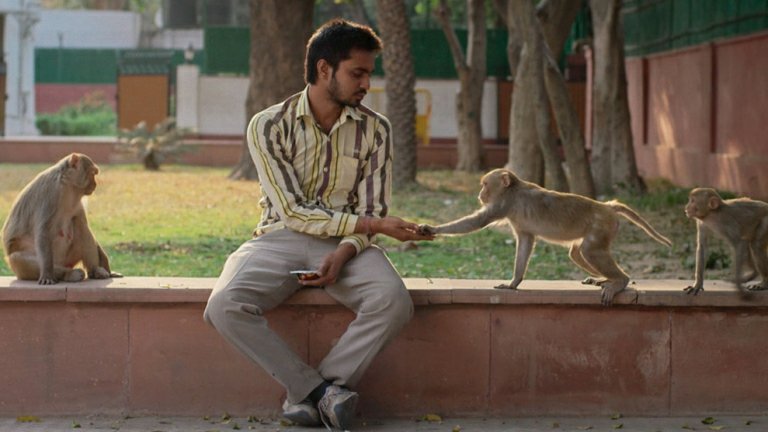
You ever wonder while looking at a watchman or a street vendor how things are at home? Not just financially but what how conditions are at home, whether he is staying with his parents or he has any kids? What does he do in his spare time, what sort of respect does he have amongst his colleagues? Prateek Vats’ Eeb Allay Ooo interrogates the inner lives of these persons who are at the lowest rung on the employment ladder.
Anjani (Shardul Bharadwaj) has a peculiar sort of job. He is hired to shoo monkeys away from a few important spots in the city. Anjani himself is only 11th Pass and is newly arrived in Delhi so this sort of job is par for the course. He is shown the ropes by Mahinder (Mahinder Nath), an experienced monkey repeller whose family has been doing this job for generations and Nath is in real life a real monkey repeller. Anjani finds the job hard but the employment situation is perilous as shown in a parallel track with his sister and brother-in-law.
Vats keeps the proceedings low-key. The business with monkey repelling doesn’t turn into a environmental parable, although there are a few hints here and there of the unfairness of the situation for the monkeys. The narrative trots along with a few choice gags interspersed with domestic drama. Some conversations could fit neatly into a Priyadarshan film, while some utilize the monkeys’ reactions. I don’t know whether these performances from the monkeys are a directorial feat or an editorial one (probably it’s a mix of both) but the scenes with them are often funny and the monkeys come across endearingly. My favourite gag though is the brother-in-law’s boss telling him “this is not a game” while they are sitting on a amusement park ride.
Brewing underneath throughout the film are the conflicts of class, about how employers treat their lowly employees. Even a little deviation from the expected pattern is punishable while benefits and generosity are hard to come by. This is especially the case with Anjani, who failing traditional methods resorts to some creative methods to get rid of the monkeys. The film eventually takes a turn for the serious but here too Vats is diligent enough not to descend into mawkishness and to still keep the proceedings low-key. Anjani’s sister is pregnant but the film does not take the conventional route when dealing with this. Many directors wouldn’t have resisted the pull of aligning the story beats with steps in her pregnancy but Vats treats her pregnancy neither as an inconvenience nor as an celebration.
Shardul Bharadwaj’s performance here is commendable. He is the exasperated worker early on, frustrated by his lack of success at work. Eventually, he becomes more and more unhinged, courtesy of both professional and personal trouble. The final scene is a triumph for both the director and Shardul. I am still mulling over it hours later and there is a lot to unpack, which is to the credit of the makers.
In Covid times, we take what we get but even if we weren’t in the middle of this pandemic, Eeb Allay Ooo would still be one of the best Hindi films of the year.
In our Covid times, theater-going feels like a thing we took for granted. Covid has hit the industry hard with theatres reeling from it’s effect. The content on streaming is only improving, but the main point of the theater vs. streaming arguement wasn’t the quality of the films, but it was about the theatrical experience. Some consider the experience overrated, that nostalgia is the only reason we haven’t let go of theatres. The theatrical experience though is much more than that. Not only does seeing a film on the big screen differ from the experience of seeing it at home (no matter how good the set-up or how dark the room is) it’s also the feeling of watching it with a audience who might or might not be in line with your opinion on the film. I watched Rustom with an audience that was equally as hostile to the film as I was and once the catcalling and booing began the film drifted to the background and we only focused on the individual lines to pass a rude comment. Conversely, by the middle of Judgemental Hai Kya the crowd had turned on the film and it felt like I was the only person still enjoying it. Both of these experiences are valuable to me even if they don’t constitute ‘good’ movie-going behaviour.
Film Festivals are of course an entirely different matter. Here, people are expected to be quiet in line with the general environment that surrounds the festival. Film Festivals are invaluable to me (my first blog posts were about them) and due to theaters being shut down film festivals have been cancelled too. We Are One contends to bring the festival home to your screens. In these times, it is the best alternative.
One can visit the We Are One YouTube page to take a look at their whole catalogue but here are five films I’m most looking forward to:
Eeb Allay Ooo: A winner at the Mumbai Film Festival (who are one of the co-sponsors of this event).
Bridges of Sarajevo: A grouping of short films dedicated to the city of Sarajevo one hundred years after World War I. Features contributions from the likes of Jean-Luc Godard and Cristi Puiu.
Shiraz: A Romance of India: An silent epic concentrated on the Taj Mahal directed by a British filmmaker. Perhaps an early precursor to the likes of Mughal-E-Azam and Fritz Lang’s Indian Epics?
Amreeka: The title alone tells you this is going to be a story of Asian immigrants to America. In this case, it’s about Palestinians.
Adela Has Not Had Supper Yet: Any film that states it’s genres as comedy, crime and fantasy is going to have me interested.
In addition, there are a number of interesting-looking shorts and talks with filmmakers and actors held at various festivals. Some of the talks to see are the ones between Oliver Assayas and Claire Denis, Steven Soderbergh and Francis Ford Coppola, Ang Lee and Hirokazu Kore-eda and Viggo Mortensen and David Cronenberg.
These films are available on We Are One’s YouTube page and you can set reminders for the films you are interested in. You can donate to the festival, although this facility is not available in India. The festival runs from 29 May to 7 June.
“Rex Reed called it the worst movie of the century. For me, [that] is a victory. “
Here Aronofsky is talking about mother! and this echoes similar statements made by the Danish Lars Von Trier and Nicholas Winding Refn, that negative reactions are just as important as positive reactions and polarization is good. Drawing a reaction is ideal and if you have done that then there’s no space for boredom. Aronofsky’s films certainly do that considering every one of his films, aside from Black Swan and maybe The Wrestler, draws varied reactions from all corners of the movie-going crowd. To some he is an masterful auteur who gets inside his character’s skins and probes their psyche in a way only he can. To others he is an intermittent hack, who coasts along on his self-arrogance and the self-importance he himself gives to his work. There are others who fall somewhere in the middle, although they may despise one film completely while thinking another great. Then there’s divisions among the film themselves. Some may be more appreciative of his mythological inspired work than others. The point is that the name Aronofsky has many different connotations for different people.
Aronofsky’s films can roughly be divided into two categories. First, there’s the body films i.e. the films obsessed with the protagonists’ bodies which include Pi, Requiem for a Dream, The Wrestler and Black Swan. Second, there’s the films inspired by mythical stories which include The Fountain, Noah and mother!. This is however, at best only a surface-level distinction since there’s no strict rule that elements from the latter don’t show up in the former films or vice versa. For example, a huge part of Pi involves the discovery of a 216 digit number that may or may not be the answer to god while in The Fountain the protagonist is obsessed with finding a cure for the decay of bodies. What it does provide though is a rough outline for how the subject is treated by Aronofsky. In his body films, Aronofsky’s camera is concentrated on the here and now and he uses a more rapid editing scheme to go with the convulsions happening within the protagonist’s bodies (The Wrestler is an exception to this) while in the mythical-inspired the camera is more relaxed (though there are still a lot of close-ups and over-the-shoulder shots) and the editing style is more conventional (again, the ending of The Fountain is an exception). What’s more interesting though is the point at which both of his considerations, the body and the myths (which are more mythical environmentalism) meet. Aronofsky seems to treat the body and the environment as indispensable parts of each other and this comes off seamlessly in his best films.
Pi (1998)
Released in the same year as Nolan’s debut Following, there are times when Pi recalls the black-and-white debut of the great David Lynch, Eraserhead. Pi ultimately however ends up taking a much more conventional approach to it’s narrative than both of those films and it’s moments of innovation are brought down by a straightforward ending.
In Pi, mathematics is philosophy. This is particularly evident in the conversations between our protagonist Max Cohen (Sean Gullette) and his mentor Sol Robeson (Aronofsky regular Mark Margolis). In these conversations, Sol warns Max of the pitfalls of going on a certain route in his findings, about seeing patterns where there are none, about the rabbit hole that is pi and about taking a break once in a while. He uses various illustrations and stories to make his points like the game of Go, but his intent remains clear, he wants to ward off Max from getting his head in too deep (perhaps even literally because Max’s head is shown to be a commodity desired by many people). Max lives in a small-scale apartment where half of the space is taken up by his super-computer Euclid. Max starts out with a ‘modest’ goal of making stock predictions but soon Max is getting numbers that are other-worldly in their aspect.
Pi sometimes suffers from being too showy and expositionery. That’s maybe a risk you take when you are trying to explain complex mathematical concepts (although in the end they are not that complex as will be seen) but some scenes just fall flat. Take, for example the scene where Max meets Lenny (Ben Shenkman), a Hasidic Jew who tries to impress Max with some quick Torah maths. It isn’t that what he is saying is boring but it’s that Aronofsky frames it in a way where he wants to show Max is being unimpressed while trying to impress the audience himself. Or where Sol tells Archimedes’ “Eureka, Eureka” story. Margolis is a fine storyteller and his presence is always welcome, but Aronofsky makes the most juvenile point through the story (plus, wouldn’t someone like Max have already heard the story a thousand times?). No, the film is at it’s best when it’s letting the imagery do the talking. The stark black-and-white grainy cinematography combined with the frenzied editing gives us a headway into the mindset of Max who suffers from various hallucinations. Of note is the scene at the railway station, which is the one reminiscent of Eraserhead, where Max follows a trail of blood and finds a literal brain. As he pokes at the brain, he hears a screeching sound. This is pure visual experimentation and you wish the film was comprised of more of this type of imagery.
Alas, the plot trudges forward and there’s a subplot with Wall Street stock dealers or something (it’s not clear who they are) that’s undeveloped and for all Lenny’s exaltation that the “Torah is all maths” what they are essentially looking for is just a sequence of numbers, nothing mathematically challenging like the golden ratio or Fibonacci numbers. This is not the most disappointing end to a storyline either. The actual climax is even more disappointing, as if Aronofsky is himself saying I don’t know what to do with this knowledge I have presented to you. I don’t want to drone on too much though because I know some of the problems may arise due to budget constraints. For a debut film plus considering how it got made, Pi if not entirely fulfilling, is still a massive achievement.
Requiem for a Dream (2000)
“The idea that the same inner monologue goes through a person’s head when they’re trying to quit drugs, as with cigarettes, as when they’re trying to not eat food so they can lose 20 pounds, was really fascinating to me.”
It’s really not what happens after taking drugs but what the characters do just to satiate their needs that’s so gut-wrenching in Requiem. Some critics have derided this film for a being a huge and puffed up “Don’t do drugs kids” pamphlet, even comparing it to a modern day Reefer Madness. But what I think the above quote makes clear and the impression you get from the film if one actually thinks about what happens in the film it’s clear that the film is actually about addiction and drugs are just used as a crutch by which Aronofsky makes his point. Is not Sara (Ellen Burstyn) actually first addicted to the game show on television that causes her to get hooked on amphetamines? In one scene her son Harry (Jared Leto) admonishes her for taking them before she explains that losing weight and appearing on the game show is the only thing she has going for her in life. We know this as we see her holed up in her apartment only the TV for company. Even her conversations with all her friends (who appear interchangeable and form an echo chamber) revolve around the same topic. People may be hooked up on the drug angle though because of the ordeal she goes through in the second half and the tricks Aronofsky uses to show the intake of drugs. He uses rapid cuts (also called an hip-hop montage) to heighten the senses, so whatever the characters are feeling, paranoia, euphoria, hallucinations, withdrawal, ecstasy, devastation you are drawn in and not allowed a moment’s rest.
Once again, on the point of the portrayal of addiction vs. a simple drugs are bad message. When all shit hits the fan, it’s only Sara who is getting her drugs. Harry, Marion (Jennifer Connelly) and Tyrone (Marlon Wayans) are all experiencing withdrawal syndromes and will go to any measure to get their fix. While this is meant as an in-film pursuit of drugs it really transforms into obsession of the kind everyone is familiar with. At some point this scrambling for drugs just starts to resemble regular human scrambling for resources. This is greatly aided by career-best performances from all four principals, but especially Connelly and Burstyn. The script reserves it’s most harrowing moments for them and both of them reveal that feminine incongruity. This is not the last time Aronofsky would torture his female protagonists and this points to a certain helplessness on the part of Aronofsky as in he can’t help but be a by-stander as women are abused (This theme is further expanded upon in mother! where Aronofsky takes a little more responsibility). Ultimately, I would compare Requiem to a bad but nonetheless essential trip.
The Fountain (2006)
Aronofsky has said The Fountain is his favourite of his own films (well until mother! came along) and it’s easy to see why. This is the most Aronofsky film and by that I mean it marries the two concerns Aronofsky has been dealing throughout his career that I mentioned before: the body and the myths through which he explores his environmentalism. Throughout the film the characters played by Rachel Weiz and Hugh Jackman talk about being afraid of death. Weiz’s character seems tranquil and resigned to her fate, accepting of the fact that death has come calling and there’s nothing she can do to change her fate. Jackman’s character, her husband and a doctor, however seems reluctant to let her go, understandably. When Weiz character says “I am not afraid”, Jackman’s character takes it as acknowledgement from his wife for the work he is doing in developing a cure that would lead to immortal life (he believes death is a disease), instead of her coming to peace with her looming death.
These scenes are interspersed with scenes taking place in the past during the Spanish Inquisition and at a uncertain time during the future (again played by Weiz and Jackman). Aronofsky draws heavily from Mayan mythology to make his point. Through these flash-backs and flash-forwards (which do in the end come together) he proves the folly of the doctor and emphasizes the necessity of death through a environmentalist perspective. Death is a responsibility, part of a cycle on an infinite timescale where every life is deemed meaningless. In the climax of the Conquistador’s storyline, he finds the Tree of Life and applies it’s sap to his wounds. The wound heals, the Conquistador thinks he has found eternal life. But, in the single most literal scene of the film, nay Aronofsky’s entire career, the body turns into the earth, instead of him attaining eternal life through the tree, the tree attains eternal life through him. This was as foretold in the Mayan tale that inspires Weiz’s character in the present day. The signal here seems to be that the only way to achieve immortality is to become one with the earth. Death itself brings a form of immortality, as in your death brings upon and sustains other life on earth. A piece of the dead lives on in these lives. Of course, how literally the past and future sections are to be taken is up to interpretation due to the framing device of Weiz’s character writing the book in which the section take place. They could just as well be interpreted as Weiz’s character’s way of saying to let go.
Science and medicine has grown to the point where average life expectancy is rising all across the globe, so it’s natural that we would want to take the next step and cancel death all together. What Aronofsky seems to be asking here is is human life worth it. Whether human life is worth interfering with nature’s balance and whether death is not only an end but also a beginning.
The Wrestler (2008)
In The Wrestler Aronofsky uses as his point of focus a washed-up professional wrestler with no internal life to speak of. He isn’t a global superstar like those WWE wrestlers but we see that he can still pack venues. He has a wrestler’s body and we can surmise that in his youth, the exhilaration one gets from performing in front of large crowds was part of why he devoted his life to wrestling. But eventually that life would be so demanding that he would have no time for his family.
When we first see Randy “The Ram” (Mickey Rourke) he is a vision of a broken man way past his prime. He still takes joy in wrestling, but after a heart attack instigated by a gruelling match beforehand, he is forced to re-evaluate. He becomes close to a stripper named Cassidy (Marisa Tomei) (which was originally going to be a ballerina before that was spined-off into it’s own film with Black Swan), while trying to right his wrongs by establishing contact again with his daughter Stephanie (Evan Rachel Wood). This seems to go on well for a while before it all inevitably comes crumbling down.
Aronofsky’s direction here is more somber compared to his earlier works. Randy is not addicted to drugs nor is he a genius trying to find patterns in nature or trying to find immortality. He is in ways, despite his mini-celebrity stature, just like any other middle-aged man who has given himself to his work at harm to his personal life. Aronofsky studies Randy’s body closely, sparing no detail. We see the toll of all those years of jumps and holds, scissors and kicks, pins and punches, supplements and steroids not only on his body but also on his face and in his eyes. Rourke is perfect for this part because while he can be explosive he has a quiet tormented manner which suggests the crisis going on underneath. He has one of those naturally inexpressive faces that is quite suitable for a wrestler, who when he steps into a ring is supposed to represent a symbol of the spectators’ own wanting machismo. The appeal of wrestling isn’t just a need for violence, it also stimulates a fantasy of (usually) men of taking shit into your own hands and fighting forces of evil. In the film, this is best represented by the wrestler Ayatollah, who is the heel. On the outside he is a nice guy who is a friend of Randy’s who ensures Randy doesn’t take too much of a toll in light of his heart attack, but when he steps into the ring he must put upon a character that is very easy to hate so that all the fans can have their power fantasy as the white Randy pummels the brown-skinned Ayatollah.
On a rewatch, I realized that Wood only actually has three scenes and her role is much shorter than I initially thought. Her character exists more as a reminder of all the things Randy did wrong and he has to now reconcile with (which he horribly fails to). Cassidy, the other female character is a parallel to Randy since her body is aging too in a field related to the body. Aronofsky thankfully doesn’t place too fine a emphasis on this point although that didn’t stop critics at the time from comparing these two professions and theorizing that they are essentially similar. Yes, both of these professions involve fantasies but stripping and wrestling can only make for a laboured comparison. It’s like comparing weight-lifting to tennis, which are only superficially comparable as sports. Cassidy does serve as a valuable companion to Randy though and fits neatly into his story. The Ballerina on the other hand would have a much harder time of it.
Black Swan (2010)
Call me a hipster. Black Swan is by far Aronofsky’s most critically acclaimed and award-garnering film, the film that could be said to have gotten him into the mainstream. But for me it’s Aronofsky’s worst film and makes me feel one with his detractors for passing of trashy material as deep. Trashy it is though and no amount of polishing can overcome that. You just can’t say it’s inspired by Rosemary’s Baby (a film that was actually aware of it’s trashy origins and knew how to overcome them) and have it serve as an excuse for a hokey character motivations and a screechy scruff screenplay.
The film traces Nina’s (Natalie Portman) journey as she prepares for her role as The Swan Queen/ Black Swan. It’s a journey into madness, a descent into hell. And yet the whole experience is cheapened by Aronofsky’s insistence to go for the obvious metaphor. It can’t be said Aronofsky is not an on-the-nose director because he is but in Swan there is an insistence that what is happening has a certain art-house aesthetic to it and there’s a sheen of paranoia like evidenced in the likes of Repulsion and Rosemary’s Baby. And yet the appeal of Repulsion is the non-definiteveness of the threats felt by Catherine Deneuve. When strange things start happening in her apartment and the apartment seems to start to swallow her whole Polanski has given us just enough to form an idea of the woman in our mind and yet he holds back enough that we are not sure of what we are seeing on the screen. Of course, Aronofsky is not Polanski and it’s harsh to expect this of him but Swan doesn’t have the narrative balls either to embrace it’s trashy trappings. A major motif is Nina seeing herself being followed by a doppelgänger. This doppelgänger is sometimes implied as being Lily (Mila Kunis), a rival dancer, sometimes it’s Nina’s idea of Lily while sometimes it’s implied to be plain paranoia. And yet here too we see Aronofsky going the obvious route. Lily is less a character than a feeling in Nina’s mind. She is whatever Nina (and in turn the script) wants her to be. This gets tiring after a few scenes and when the inevitable sex scene happens (because let’s face it this is a film with art-house aspirations and one easy art-house stereotype is lesbian scenes between rivals) (see also: American Hustle) the next day Lily denies this ever happening and taunts Nina. This proves Aronofsky’s insistence to not just let scenes lie. Not only does Lily have to deny it but also mock Nina to her face but in a sultry tone to the consequence that any ambiguity goes out of the window. I was half-expecting by the end a Fight Club-like twist where Lily is all in her mind and in a way that happens too. But that isn’t even the worst scene of the film. That’s the one where a shouty Winona Ryder comes yelling at Nina about how she will age too and somebody younger will come as her replacement. This scene feels like self-parody, especially coming on the back of The Wrestler where aging was a reflective topic, not made fun of like it is here. Doesn’t help that Ryder is terrible and she dies quickly after leaving the scene all but purposeless as the film quickly shifts focus from Vincent Cassel’s character to Nina’s fight with the apparition that is Lily.
Black Swan and The Wrestler first started out as one film. That would have been an interesting dynamic to see, the two worlds of ballet and professional wrestling colliding, the former considered elegant and refined, the latter coarse. But while The Wrestler survived on account of it’s bare bones story and a somewhat realistic style (that film didn’t need dream sequences to be taken seriously) Swan crashes because of a lack of awareness of what it’s really about.
Noah (2014)
Rather than an anomaly in Aronofsky’s career Noah may be more of a stepping stone. Aronofsky’s career path seems pretty straightforward all considered. Preppy young filmmaker starts with low-budget indie then works on the fringes of the mainstream for about a decade before getting his big break (meaning awards attention) and therefore being able to get the backing of studios to make a big-budget epic and then when that film becomes a hit using that goodwill to make a story more closer to his previous style just with a bigger budget. That would be a cynical way of looking at it though because Noah doesn’t feel like a sell-out and it isn’t because in a way Noah lays out the carpet for mother!’s biblical revisionism.
Noah features a lot of scenes where a character tells another character stories. Aronofsky has said various times he is drawn to biblical stories because they were the first stories and formed part of the earliest canon. Aronofsky is telling us stories himself but just like any other narrator he puts his own spin on the stories. Depending on what Abrahamic source one is reading these stories change form and in his hand too he molds the story to suit his need. Like in The Fountain he uses these myths to convey a mythical environmentalism, or in this case more specifically Judeo-Christian environmentalism. When Noah gets his revelations of God, the film’s treatment of Noah’s interpretations are definite but there’s also room for doubt whether Noah is following God’s instructions to a tee or whether Noah’s free will impacts his choices. Noah decides that all animals, in pairs, are the only beings that deserve to be saved and that must mean the end of mankind. God’s anger at mankind’s treatment of earth (mining is carried out by the descendants of Cain) is equated to today’s concerns over global warming, the film implying that humanity’s mistreatment of the earth has been a constant since ancient times and that as a species we go through the same cycle of problems (which explains why Aronofsky went to the Biblical stories). It is prophesied that Noah’s flood will come again and once again we see in it the same foreshadowing of the doom that awaits as sea levels continue to rise. The film’s words are creationist but it’s images are evolutionary.
Of course, there are differences too. Aronofsky ends with a note of hope with only a implied indication that the flood will come back, not the sinister tone of the Christian myth that postulates that the flood will definitely come back. Plus, Aronofsky also has a vegetarian agenda here that is missing from the original myth (in fact in the original story God allows the eating of animals as long as you don’t drink their blood).
Much of the discourse surrounding Noah has been centered around Aronofsky’s decision to turn the story into a Hollywoody action blockbuster. While I didn’t mind the action so much (much of it is to reinforce Noah’s guilt at letting all these people die) I did think the script is a bit weak. Like in Pi, I found the imagery fascinating but I also found parts that are over-explaining the themes. Perhaps Aronofsky was aware he was making a film for a big studio that expected the film to be a commercial hit and the vagaries of modern studio filmmaking are to be blamed but it brings the film down several notches. But I nonetheless find the film to be fascinating and don’t think it deserves the condescendation with which some people seem to treat it with.
mother! (2017)
If Noah was a classic protagonist in fear of God’s word and entirely loyal to him then Javier Bardem’s character in mother! is the post-modern “I am the author of this story and therefore I myself am God.” Noah at end of the film has to make a hard choice but at least he has the luxury of a choice unlike Jennifer Lawrence’s character here whose path is telegraphed and she has to follow this path without respite, a path of nothing but despair and pain. Unlike Noah, mother! at least at first seems to take place in the real world. From the first image we know that the idyllic existence of Mother and her husband (or whatever you want to call him, Him, the Poet or even God) is not going to last for long but depending on how much one knows going into the film you don’t know exactly where it’s headed until about half way through. Noah theorised that God is punishing humanity for it’s evils. mother! is more cynical. It theorises that He himself is responsible for all of the destruction of mother earth and the humans act as nothing but his agents and that mother must suffer cyclically for that is her journey.
Mother is most always dressed in white. She has long blonde hair and she is hapless. She is played by Jennifer Lawrence, whose face takes on a helpless quality even at the slightest hint of something wrong. When Ed Harris’ character first enters the house you get an inkling that he is not to be trusted. He appears friendly and hits it off with the husband but it’s all there in Lawrence’s face, the doubt and the misgivings. It doesn’t take much time for her life to devolve into chaos and Aronofsky piles on the misery on mother, first psychologically and then physically. She is trapped inside the house, trapped in her love for her husband trapped in an out-of-body experience. Amidst all the carnage, there’s a sequence with a sink that hits all the wrong notes in all the right ways.
Aside from the Judeo-Christian environmental message, there’s a few other ways to read the film. Some of the scenes where mother is at height of her trauma recall the scenes in Requiem for a Dream where Burstyn and Connelly’s characters are at the end of their rope. While that film was focused solely on the destructive powers of addiction, a message implicit was the systematic treatment of women. In mother! that feeling of seeing her suffering on the screen is punctuated by the fact that this is enabled by her husband, that women suffer at the hands of men but also because of a system that allows other people to turn a blind eye (other women are included in this). This oppression may also be justified by the husband sacrificing her in the name of artistic gratification. The adoring fans, which the husband lets take over his house are a manifestation of his large ego, letting the fame get to his head. But, as is the case his wife’s well-being falls by the wayside. Mother fights her own battles, first renovating the house by herself and then fighting the intruders in the house her husband being notoriously absent when she needs him the most. And what does she get for all her trouble? “Ah, the inspiration” says Kristen Wiig’s publicist, again just making her a part of what makes Him. She is left no individuality, like many women before her who have to bear the sacrifices because “the husband is the one who works and earns money and without him they would have nothing.”
But foremost of the message mother! wants to convey is environmentalist with the help of Judeo-Christian myths. Mother is mother earth and the m is not capitalized, not only to signifying her vulnerability, but also because she is a place of warmth and to address her informally comes easily. She is God’s creation and sometimes even feels like his plaything. He gets her pregnant but then rips away her child from her. Humans are a plague that he sets upon her and they trample her. He, however doesn’t seem concerned even offering their son, Jesus born of God and also of the earth, making him die for humanity’s sin and then being devoured, suggesting the story of Jesus to be some sort of masochistic fantasy. When mother burns down the house she herself lovingly built, he doesn’t seem to be affected, instead asking for her love and taking her heart. A cruel god who turns his legions of devotees into fanatics who’ll do anything in his name they ultimately destroy mother and it seems that’s what the task given by him is to his people. And yet when she is destroyed another takes her place and the cycle repeats. No matter how far we get, the Hims of this world know how to prey on our devotion and turn it into fanaticism and the cycle of violence and war repeats and the earth suffers.
Miyazaki and Takahata had years of experience in animation before starting Studio Ghibli. They had done extensive TV work, both writing and directing and in the case of Miyazaki doing the animation as well. Now, I have not watched most of this work, but it’s safe to say that, working as they were for the industry’s studios they would have to comply to certain norms and they wouldn’t be able to experiment with genre much either. It was only when Studio Ghibli was established, that the two made their name in the world. Miyazaki would be more prolific of the two while Takahata would only direct sporadically with more than a decade between his last two films. Takahata would be the more experimental of the two (both in form and content) and it is for this reason that I admit flat out that I think Takahata is the greater of the two. That’s not to say though that I think anything less of Miyazaki than a master. Both of these directors would craft stories that are personal to their hearts and share some of the same concerns (such as anti-war and environmental messages) as well as a reputation for crafting engaging and thoughtful protagonists, most of them women. This was important to Miyazaki as he criticized the Japanese animation industry at the time for drawing and making it’s female protagonists as objects of fetishes (something which still happens to this day). Ghibli would be shut down eventually and Miyazaki would retire (although he has a new film on the block) while Takahata would pass away in 2018. This means we have a definite body of work for the both of them and every one of their films is worth watching.
Note: As I alluded to before I haven’t seen most of their pre-Ghibli work which means I haven’t seen the three films Takahata made before the founding of the studio.
Lupin The 3rd: The Castle of Cagliostro (Miyazaki, 1979)
Even if one has never watched the TV show the film is based on (or even heard of it) Lupin is a breezy two hours, a mix of action, humour, romance and of course being a Miyazaki film wonderful animation, a precursor of sort to Porco Rosso. Arsène Lupin III (voice of Yasou Yamada) is a master thief who in the film’s opening sequence steals a casino along with his accomplice Daisuke Jigen (voice of Kiyoshi Kobayashi). Enough money to fill their entire car, except of course the money is all fake and Lupin tells this cheerily to his partner and together the partners dump the money on the highway. This opening scene sets an easy tone for the film, introducing Lupin as a a cheery lovable criminal who’ll fall in love with Clarisse (Sumi Shimamoto) and become a hero through the course of the film. Miyazaki changed the character considerably from the original who was far more of an anti-hero with his creator even stating Lupin would have raped Clarisse. Of course, you can’t have this in a Miyazaki film and it’s all the better. This is the most traditional of Miyazaki’s films, with Miyazaki working as a gun-for-hire and making a film in Japan’s considerably huge animation system. There are a few distinctive touches of the director though, especially the ending where the titular castle collapses to reveal ancient Roman ruins, the first hint of Miyazaki’s primary concern in many of his subsequent films, that of humanity’s greed destroying nature. Lupin is not essential viewing by any means, but it’s not a throwaway either, showing a master’s early flourish.
Nausicaä of the Valley of the Wind(Miyazaki, 1984)
The film that directly led to the formation of Studio Ghibli, Nausicaä is also responsible for other firsts. The first film from Miyazaki to have a strong female protagonist at the center, the first of his films to deal with anti-war messaging and environmental concerns. Unfortunately, it is also the first of his films that I think suffers from the primary with Miyazaki’s weaker films, namely the overstuffing of the plot. Here, at least it can be excused as pertaining to certain demands an anime film requires. I liked this film and I was completely with Nausicaä all the way of the journey but there were some things that simply did not gel. There was one character too many, one obstacle too many, one case of deus ex machina too many. I am not advocating here for the film to be shortened or Miyazaki be censored in any way. Rather I wished the film would concentrate more on the central story and the environmental themes of the film. As I said though I liked the movie if not falling in love with it. Nausicaä (voice of Sumi Shimamoto) is a very compelling protagonist and the scenes involving her and the Ohms are thrilling. Plus the sci-fi premise, unique among Ghibli films, makes it the only ‘metal’ Ghibli film. The sea of decay sequences too are very well done lending themselves to some beautiful animation. All in all, worthy of your time if not masterclass.
Laputa: Castle in the Sky (Miyazaki, 1986)
Laputa is a first-rate actioner from Miyazaki, but it also points towards the more somber and ideological turn his films would take later, not the least of which is My Neighbor Totoro which only came two years later. The story is your standard anime action/adventure stuff. One night Pazu (voice of Mayumi Tanaka) sees a angelic little girl falling from the sky, except she is falling slowly, a stone’s magic preventing her from coming to any harm. The girl is Sheeta (voice of Keiko Yokozawa) and the boy and the girl quickly fall for each other. As revealed, Sheeta is actually a princess of a castle in the sky called Laputa and she is chased by both pirates and the army led by Colonel Muska (voice of Minori Terada) who has his own connection to Laputa. You know, standard stuff and the plot trudges along somewhat predictably though there are a few twists and turns with the usual dose of comedy. It’s in the individual moments that the film shines however, like the robots who earn your sympathy without uttering a thing. Or the first landing on Laputa, where Miyazaki allows the protagonists to just wander around trying to make sense of this new world. Their first experience of it is unexpected, the island all covered with branches and a few helpful robots. Miyazaki here is conveying the perils of power, and the inevitable destruction that follows. But the decay is so peaceful and quiet and the branches ultimately aid our heroes in their fight, quite literally getting in touch with your roots. I am of two minds whether Miyazaki’s positive depiction of miners undercuts this. Miyazaki was inspired by Welsh miners on strike, but there feels something wrong about lionizing miners by a director who’s main obsession has been the destruction of nature at the hand of man. Still, it shouldn’t take away from the fact that Miyazaki here has made a terrific genre piece.
My Neighbor Totoro (Miyazaki, 1988)
Totoro is unlike any other Miyazaki film. Miyazaki’s characters usually go through character arcs in line with narrative beats, the overarching plot being the narrative engine that helps the film propel forward. That is not to say Miyazaki’s characters are in service to the plot, but a complicated plot is a characteristic of his films. Totoro does away with this, it’s narrative being more similar to Takahata’s Only Yesterday in that both films focus on the trials and tribulations of girls in their formative years but without the help of a typical plot. The result is a film that feels intimate and personal in a way that animated films rarely do. Totoro as a character himself is also pretty singular. A fluffy cross between a bear and a cat (certainly the cutest otherworldly creature in Miyazaki’s films) he is a non-speaking spirit who like long naps and doesn’t mind when the younger of the two sisters Mei (voice of Chika Sakamoto) starts playing with him. With the two sisters’ mother in the hospital and the father busy in his work, he acts as a sort of surrogate parent to the girls. But the girls seem to delight Totoro too and the film has many a joyous sequence highlighting the quality of the animation and the bond between the girls and Totoro (the cat bus is a stroke of genius). And yet there is a inherent sadness, with their mother being in the hospital and at one pivotal moment you fear the worst. Miyazaki’s own mother had tuberculosis and thankfully she survived and the mother here survives too (you can’t help but think though that she probably would have died in a Pixar film). But the lasting image of the film is the scene at the bus stop with Mei sleeping on the back of her older sister Satsuki (voice of Noriko Hidaka) with Totoro standing beside them in the rain with only a leaf for cover. No wonder they made him the studio’s icon.
Grave of the Fireflies ( Takahata, 1988)
Through the years Ghibli has created an array of cute girls, one or two for every film. None has been as tragic though as Setsuko (voice of Ayano Shiraishi). A character almost designed to make you cry, we know from early on her destiny and as we sit powerless, not being able to do anything, we pray her suffering is lessened as she reaches her inevitable fate. Her big brother Seita (voice of Tsutomu Tatsumi) does everything in his power to care for his little sister and we feel for him too as do we for the millions of people affected by the war. Takhata said, ” (The film) is not at all an anti-war anime and contains absolutely no such message.” His images give the lie to his words though. From the first image to the last Grave becomes one of the most emotionally draining anti-war documents ever made. Unlike Miyazaki, Takhata wasn’t interested in animating itself but the power of animation to tell a story. The animation gives an additional vulnerability to the characters while allowing Takhata to show the full range of the devastation in a way live-action would not permit. But this is also a story of the bond between two siblings who have life’s hardships thrust upon them. After their house is destroyed in a bombing and their mother dies, Setsuko and Seita move in with their aunt. The aunt eventually gradually turns on them and the siblings are forced out again. But there’s no demonization here, the film hints at her own hardship and this is not her normal countenance. Again the point being made on a micro level of how war brings out the worst in people. After being forced out the siblings live the life of nomads scraping out a living as best as they can which isn’t much. This third act is devastating and may make the most hardened of grown-ups to cry. I know I did.
Kiki’s Delivery Service (Miyazaki, 1989)
Kiki’s Delivery Service was adapted from a novel by Eiko Kadono. The novel is originally of a much more episodic nature and one can see Miyazaki trying to make a narrative out of all this, to make a real Miyazaki film. Unfortunately this leads to a fumbling and indecisive film which has no idea what it wants to be. This could be forgiven for a film doesn’t need to have a straightforward or consistent plot to succeed if the content itself demands it or the content is strong enough. Kiki doesn’t deliver on that front either. At the end of the film, Kiki (voice of Minami Takayama) says she loved this town. I was unconvinced. I hadn’t seen enough for me to have any opinion. The town Kiki settles in initially treats her harshly until a chance encounter with a friendly baker convinces Kiki to stay in the town. Things happen too easily and solutions are also easily found. For instance, when Kiki loses her powers (the reason for which is cryptic and I am not sure it needed to be, another pitfall of the adaptation I think) she goes to live with a friend she met earlier where the friend, who is a painter compares her loss to artist’s block. When she does regain her power it’s in the climax when she is rescuing a boy she is friends with. This whole characters arc to me seemed frivolous and pointless, and it doesn’t really provide for anything resembling emotional attachment to the characters. At times, I was bored like Kiki herself is sometimes. I wonder if Takahata (who was considered to direct early on) would have been a more appropriate choice, since he proved he is comfortable with episodic narrative in both Only Yesterday and My Neighbors the Yamadas. Lest you think I hate the film, I don’t. I did find find things to admire, like the cat Jiji (voice of Rei Sakuma) and I did find the early sequences where Kiki leaves home and settles in the town pleasant. It’s just not something I would heartily recommend.
Only Yesterday (Takahata, 1991)
One can easily imagine Yesterday as a live-action film. This is reflected in the animation too, with the characters having more realistic facial expressions and the overall animation having a more non-showy quality to it. The characters and their emotional journey is firmly at the centre of things here. Adapted from a Manga, only the scenes where our central character Taeko (voice of Miki Imai when adult and voice of Yōko Honna when child) is a child are adapted directly from the Manga. The adult sections are purely Takhata’s invention and they elevate the film from just being a snapshot of a girl’s childhood to being a full-fledged drama with three-dimensional characters. The adult sequences provide a bookend to the child sequences, allowing the viewer to view them from a distance, so when the child Taeko has a first crush or is struggling with Maths, we view it from the lens of the adult Taeko, with a mixture of nostalgia and embarrassment. And the adult sequences find Taeko a fully-formed character arriving at a farm and questioning herself as to what direction her life is heading in. There’s no hyperbole and no firm stances here. In fact, the unsureness of Taeko makes her feel more relatable and the film makes a sure stand of not romanticizing her childhood. For example, when child Taeko wants to take up acting in a play, her father firmly refuses. Adult Taeko is shown reminiscing over this, but she accepts it with a sense of inevitability, that that sort of life may never have been for her. So, when the time comes for deciding whether to go back to Tokyo or stay behind and live with the lovely Toshio (voice of Toshirō Yanagiba) she runs away and contemplates whether it’s worth taking a risk. This culminates in a wonderful, heart-tugging ending sequence. Here, “the memories come tumbling down” as the original Japanese title says.
Porco Rosso(Miyazaki, 1992)
Porco Rosso is usually not considered in the top echelon of Miyazaki’s works. This maybe because of it’s origin as an in-flight film, it’s more comedic aspirations or because it’s more genre inspirations like the World War II adventure film and noir. Miyazaki himself doesn’t think highly of it, regretting the film taking a more serious approach in response to the Yugoslav War. But for me this injection of seriousness into the otherwise breezy narrative is welcome. It only seems to highlight the absurdity of man’s penchant for violence and it also gives depth to the characters, not the least of which includes Porco (voice of Shūichirō Moriyama) saying “I’d much rather be a pig than a fascist”. The comedy works too because Porco himself is so charming. Porco combines Miyazaki’s love for flying with Miyazaki’s love for pigs. His love for flying had shown through in his previous films and would culminate in his magnum opus The Wind Rises while the pigs Miyazaki uses as an allegory for man’s greed. Porco is the Miyazaki version of the classic Hollywood hero, a little Bogart, a little Cary Grant. Despite being a pig he is well-liked by almost everybody. The aerial fights are very well executed, with the finale being a mix of high-octane action and a parody of testosterone infused action heroes parading their masculinity. For me, this is essential Miyazaki.
Pom Poko (Takahata, 1994)
Takahata never was afraid of tackling some serious issues through his films head-on. His films are political in an upfront manner, unlike Miyazaki who uses allegories and symbols. The concept of Pom Poko is simple enough. A tribe of tanuki (raccoon dogs, though they are subtitled as just raccoons) are threatened when a new urban development encroaches upon their area. The raccoons are shape-shifters and decide to use this technique in their fight against humans. To go the safe route would have been pretty easy with this concept but Pom Poko goes to seem pretty dark places. For example, some of the more militaristic of the raccoons like Gonta (voice of Shigeru Izumiya) have no qualms about killing a few humans. The film doesn’t go easy on the raccoons either, showing them as lustful and gluttonous. An early scene shows the elders of the tribe bribing the youthful leaders with MacDonald’s burgers. This is a film that has a real satirical bite to it. Consider for example, the scene in which Gonta stages a Animal Farm-esque coup d’état and holds all the members of the strategic council at his mercy. Somehow or another the conversation turns to food and the captors start reminiscing over all the tasty food, with Gonta himself swooning over it most and the coup is called off. The comparisons to Animal Farm don’t end there. After a devastating ending for some raccoons, the raccoons who are able to shape-shift decide to finally live as humans and try to co-exist with them, recalling the similar ending to Orwell’s novel where the pigs cannot be differentiated from the humans. Despite their fanciful powers the raccoons are helpless against humanity and the melancholic ending cannot help but infuse a sadness not only on account of the raccoons but for all the damage already done by the humans. The centerpiece of the film though is a parade done by the raccoons as a power demonstration to frighten humans (as usual this fails). The quality of the animation, while already quite strong reaches a new height here. This is a wonderful hypnotic sequence and one can imagine the animators just letting their imagination run wild. One of the masters during the parade declares “Matter is void, form is emptiness” and one imagines whether he is not ruing this war between the raccoons and humans as raccoon or human we will all return to the dust.
Princess Mononoke(Miyazaki, 1997)
Mononoke’s beginning is promising, a more violent breed than anything you expect from Miyazaki. Particularly, the sequence where Ashitaka (voice of Yōji Matsuda) lops off an head gives an indication that this is not going to be especially kid-friendly. It’s a good groove to get in and I was ready for a violent fantasy epic. Alas, the film never delivers on the promise. Once Ashitaka leaves his village to find a cure for the curse that is afflicting his body, the narrative moves rapidly and the result is a convoluted mess. There’s too many elements at play and in all this the film’s message gets lost somewhere. Another thing that irked me was the character of San (voice of Yuriko Ishida) . Miyazaki has created numerous fantastic female heroines and one reason he is so beloved is the considerable personality that these female characters have. But I couldn’t really feel for San. Of course, she is an intentionally ambiguous character and our sympathy with her is meant to be built as the film progresses but there was never a moment where I felt this was the turning point and now I understand San’s motivations. Compare this with the slightly bland Ashitaka and the action practically dwarfs the characters. Being a Miyazaki film, the main characters are never in any danger of dying, Miyazaki not the type of man to use a main character’s death for the sake of a twist or thrill. But it’s astonishing how often Ashitaka gets by with a bit of luck or help.
The message of the film is one we can agree on a general level, but having sat through the film I wasn’t particularly concerned about what happened to Irontown and the surrounding forest. On a subconscious level, I think the comedy being scant also pegged at my mind. The comedy often builds character in Miyazaki’s films and it’s absence was severely felt. Mononoke, because of the expectations it builds in the first half ends up being a massive disappointment.
MyNeighbors the Yamadas (Takhata, 1999)
Boasting a minimalistic animation style done digitally, Yamadas is at least at first a collection of sketches centered around the central Yamada family. The sketches certainly reminded me of childhood Japanese shows I watched like Shinchan and Ninja Hattori and I wondered if the film would entirely comprise of these sketches. But late in the film there is a sequence that has some thematic subtext to it and introduces a little drama and conflict into the narrative. But that’s not to say the film leaves behind it’s wholesome comedy aesthetic and it’s excursion into drama is a momentary thing. However, the sequence does betray an extraordinary sadness on the part of the father (voice of Touru Masuoka), an underlying insecurity that he would come up lacking when the moment appears. The film then descends into fantasy on part of the father, something more suitable to the children and is more in line with the film’s tone. If I am making the film sound dark, that is not the case. This is a frequently uproarious comedy (the sketches are hit-or-miss, but mostly hit) and is the funniest film from Ghibli (bar maybe PomPoko). It’s just that when the comedy is so relatable, the humor can’t help but sting a little.
Spirited Away (Miyazaki, 2001)
Chances are when people hear Ghibli, they think Spirited Away. Ghibli’s most famous and successful film it’s not difficult to see why. It’s a perfect blend of humour, fantasy, action and the deep-lying environmental concerns of Miyazaki. Apart from The Wind Rises, this is the film most essential to understanding Miyazaki’s philosophy. Consider for example, the stink spirit who turns out to be a river monster polluted beyond recognition. The film takes this constant swerves that are not directly related to the main plot and yet are important to the film’s flow. And at the end, when our main character Chihiro (voice of Rumi Hiiragi) reaches Zeniba’s house the film achieves a ethereal quality. Thereon as the film reaches it’s climax Chihiro has learned her lessons and understands the havoc caused by tampering with nature. She sets about correcting wrongs and in the process helps out the members of the bathhouse stand up to Yubaba (voice of Mari Natsuki).
But what makes Spirited Away such an excellent film are the excellent fantasy creations. From the aforementioned Stink Spirit and Yubaba to No-face to the baby Boh, the creations are sometimes creepy, sometimes endearing, sometimes crude, sometimes cute. There’s a scene eary on which recalls a similar scene in My Neighbor Totoro, in which Chihiro stands next to a mustachioed, cuddly giant of a spirit in an elevator and they ride the elevator silently. This scene perfectly encapsulates the extent of the world-building that Miyazaki has achieved here. Chihiro is confused and out of sorts, but this is a gentle giant and the first indication that the the members of the bathhouse are not cruel, just a bit misguided. And then there’s Haku (voice of Mari Natsuki) who guides Chihiro through this world and he himself is a river spirit, again a comment on pollution.
Spirited Away, like The 400 Blows is a film that I wished I had come into my life earlier when I was in school. For films like these are invaluable at this stage and it is such a pity that it is often outside forces that determine what kind of media we consume. This is a film that would have been right up my wavelength at the time and I suspect it would be for other children too.
Howl’s Moving Castle (Miyazaki, 2004)
Howl is a film that should really appeal to me. Chucking narrative sense out of the window, Miyazaki instead goes about exploring and stretching the narrative to make more room for his anti-war agenda. It’s like taking a trip inside Miyazaki’s psyche. So why does Howl elicit nothing more than a cold shrug from me? Is it because the whole film seems like an excuse to get the villain Madame Suliman (voice of Haruko Kato) to say the final line about the futility of war? Is it because despite being applauded for giving old women their due, the film doesn’t actually give them a proper representation? Or is it because again Miyazaki gets so caught up in his own world and narrative that the film’s message appears at best heavy-handed and doesn’t become the grand scrutiny of war that it’s supposed to be?
Miyazaki was outspoken about his opposition of the Iraq War. This was a film meant to be a direct response to that war. And yet when Suliman utters her final line about the pointlessness of the war, the line sounds like a throwaway. Throughout the film Suliman (I.e. Miyazaki) has made the characters go through so much, that it can’t help but come across as manipulative. What we end up with is a film that seems important on the outside but is clunky and too engrossed with itself on the inside (kind of like the castle itself). That said I’m not entirely negative on the film. Some of the visuals are truly breathtaking (although some of them do again reinforce the force-feeding of the message) and the film is at it’s best when Sophie (voice of Chieko Baisho) first enters the castle and starts cleaning it. But this also leads to another problem I have with the film. Once Sophie has turned into a old woman, the film can’t wait to turn her back to young Sophie again, any of it’s messages like beauty being not essential in understanding and sympathy appearing half-assed. I truly do wish Howl was better but unfortunately it is not.
Ponyo (Miyazaki, 2008)
After the ideological overkill of Howl, Ponyo comes as a nice relief. There’s a point where Ponyo’s father Fujimoto (voice of George Tokoro) talks about the damage done to the ocean, but as a whole the film remains bereft of any grand point. That does not mean however, the film does not have any heft. Rather, this riff on The Little Mermaid far exceeds that iconic but badly overhyped film.
I feel like I say this about every Ghibli film, but the quality of the animation is just brilliant here. Whether it be the waves transforming into water creatures, Ponyo’s thousand sisters following Ponyo or Ponyo’s mother, the big and beautiful Gran Mamare (voice of Yūki Amami) appearing out of the sea the world the animation creates is immersive and you ready for the sea to swallow you up as well. Ponyo (voice of Yuria Nara) is a sweet little fish who wants to get out of her father’s control and become a cute little girl. She is aided in this by Sosuke (voice of Hiroki Doi) who gives the fish her name. There are no villians here, with the tsunami created by Ponyo and her father’s actions being a representation of the anger of the sea and the characters banding together during times of the Tsunami and helping each other out. The reason Ponyo succeed where The Little Mermaid doesn’t is the genuine friendship and relationships that happen during the way instead of the Disney film where rote Disney formulas are followed with personality traits being given by the creators rather than coming naturally to the characters.
If you want to get people hooked on Miyazaki or Ghibli, Ponyo is a great entryway.
The Wind Rises (Miyazaki, 2013)
Miyazaki’s own father was the director of a company that manufactured rudders for airplanes in World War II. So, it’s fair to say Miyazaki’s love for airplanes was born at a young age just as the protagonist here Jiro Horikoshi (voice of Hideaki Anno), who also acts like a ideological insert of Miyazaki, while the other characters act as ideological inserts of Japan itself during World War II. Miyazaki always felt guilty about leading a affluent lifestyle due to his father’s work, feeling like he profited from the war. This is the central conflict of The Wind Rises as well, as Jiro sets forward in his ambitions to design state-of-the-art airplanes all the while knowing his airplanes will be used in the war to destroy god knows how many lives.
Planes are majestic creatures, a fantasy of humankind to conquer air having already conquered land and water. Throughout the film Jiro is visited in his dreams by Italian aircraft pioneer Giovanni Battista Caproni ( voice of Nomura Mansai) and they discuss planes and what these mean to them. Earlier in the film, Jiro had rued the lack of technological development happening in Japan regarding airplanes. Caproni tells him Italy is poor too and that innovation in planes can only be beneficial to mankind. Jiro visits Germany to understand their superior aircraft and is amazed. And yet he also witnesses the racism of Nazi-era Germany. Here again, the moral cost of modernity is pondered upon. Jiro sees two kids at a bus stop, waiting for their parents to return from their late-night jobs. The kids look hungry and Jiro offers them food, but they run away. Jiro wonders how many disenfranchised people would be fed at the cost it is taking them to build planes. Miyazaki has always been critical of modern technology and yet is convinced of the necessity of airplanes. This is a film which is a reconciliation of this belief, despite the very real cost of war. Jiro however, leaves these concerns by the side and hunkers down to work. This is only heightened by him falling in love with Naoko (voice of Miori Takimoto). Now, Jiro is doing this not only for himself, for Naoko has tuberculosis. The ending is melancholic. He is visited again by Caproni, and he complements him on the Zero airplanes. However, Jiro tells him not one of them came back. Japan was devastated by air raids and his wife Naoko is dead. Caproni still believes he has built a magnificent aircraft and tells him not to regret his feat, while he also has a vision of his wife. In the end, Wind is a film about a man caught in the midst of a turbulent period in his country’s life and yet who has ambitions that will be used by his country to war. It’s a pacifist’s struggle and the film doesn’t judge Jiro for following his dreams whatever the consequences.
The Tale of Princess Kaguya ( Takahata, 2013)
Princess Kaguya is a painting-in-motion. It might seem redundant to say it about a animated film, but the watercolor animation ensures that every frame has the quality of a painting. Takahata is comfortable in not rushing the story which means the story’s measured pace let’s the drawings come to life. Many of the scenes are individually almost-paintings. The background will be still, while only one character shows a change in expression or only one bird is flying. Takahata’s previous film MyNeighbors the Yamadas evidenced a minimalist animation style too but there the animation got out of the way of the story, while here the animation is integral to the story.
The tale itself is simple though highly allegorical in nature. Princess Kaguya (voice of Aki Asakura) herself is a highly indefinable protagonist. Even the name Princess Kaguya is given to her, her origins being mysterious until the end. Rather, in the way her father tries to control her and in the way her suitors think of her as an achievable object and in the way her mysterious origins turn out to be otherworldly, making her suffering seem unnecessary she seems to resemble rather than any Ghibli heroine, a Lars Von Trier-heroine with parallels to Dogville especially potent. When it is finally revealed whence Kaguya came from, one wonders what was her purpose on descending upon earth. She is a mystical being who her father believes is a gift from the gods, which also means her father believes they have a destiny in mind for her. And thus the child is confined, literally and metaphorically, to a struggle every girl is all too aware of. But maybe that was the point. All the frustrations and the general joylessness of her period on earth combined with the happy memories she had of her earth-childhood add up to make a complete woman, or at least the replica of one. Maybe the monotony of her adulthood is equally as important to her experience on earth as the free-wheeling adventures of her youth. And the gods have sent her here not only for her sake. Her mother and father (voices of Takeo Chii and Nobuko Miyamoto) don’t themselves have a child and so the princess must fulfill the purpose of the daughter, one for the mother to fulfill her motherly duty of breastfeeding and being a general support centre and for the father to perform his fatherly duty of providing for her needs and stifling her spirit. Sutemaru (voice of Kengo Kora), a childhood friend and crush is a given a brief respite by her appearance. His general direction of life doesn’t change at all, but the princess provides a wishful glance at what his life would have been like had he not been tied down to his circumstances. The noblemen who try to court her are given lessons in their own shortcomings while the emperor is shown that just because he is the emperor doesn’t mean he can have whatever he wants or do whatever he thinks.
Princess Kaguya is an elegiac film and there may be times when the tone becomes so mournful it becomes unbearable. But that’s part of the experience and the wonderful animation is in line with the emotions of the story. This turned out to be Takahata’s last film and this is a crowning achievement for maybe the greatest auteur in the field of animation.
In Summary
Best film(s) : Pom Poko/ The Tale of Princess Kaguya
Miyazaki’s best film(s) : Spirited Away/ The Wind Rises
Worst film : Princess Mononoke
Takahata’s worst film : My Neighbors the Yamadas (what to say, his resume is spotless)
Best on a lazy afternoon : Porco Rosso
Best to watch with family : My Neighborsthe Yamadas/ Spirited Away/ Ponyo
The image above may not be the best quality but it leads to one of the best gags in the film.
I can’t remember having not watched Ashi hi Banwa Banwi. It is on TV constantly and is quoted endlessly. It is what one would call a ‘touchstone film’. A film filled with gags that have stood the test of time and paradoxically, actually sometimes get funnier the more you watch them. There are a few factors at play as to not only why the film seems timeless but also why it has burrowed itself in people’s mind the way few other commercial comedies of that period have.
First, there’s the plot. Adapted from Hrishikesh Mukherjee’s Biwi aur Makan, the plot has the Mukherjee-ian touch where the protagonists trick people, who are usually elders who won’t let go of preconceived notions. A Mukherjee protagonist though isn’t malicious or devious, and he does what he does out of sheer desperation. In Banwa Banwi too our protagonists are desperate after being evicted from their rented home by the owner (Sudhir Joshi, sometimes naive, sometimes cruel, a classic foil). This housing crisis leads them to the door of Lilabai Kalbhor (Nayantara) . The house is nice but there’s one caveat: Lilabai only allows couples to rent her house. Lilabai is half-blind with one lens of her glasses cloudy. This represents her duality. Owner of a nice house but which can only be occupied by deceiving, nice and motherly by nature but will also eavesdrop on your conversation. So, it is the four protagonists (Ashok Saraf, Laxmikant Berde, Siddharth Ray and director Sachin Pilgaonkar) decide to pose as couples (this realization is preceded by another witty scene involving Bal Gandharava, famous for playing women on the stage, and to whom the film is a tribute to) with the characters played by Berde and Pilgaonkar donning makeup and dressing in saris.
What really makes this film is the acting. None of the actors are out of their comfort range as such as they riff on their own star persona (except Ray). Saraf plays the straight man mostly albeit one who isn’t afraid to get a sly dig in. His one-two with Sudhir Joshi is the stuff of legend. But the film really belongs to Berde (affectionately known as Lakshya). He was perhaps the greatest comic of the Marathi screen, combining the lewdness of Dada Kondke with a small-town naivety that was entirely his own. He was the flabbergasted youth, in service to the whims of his seniors and sometimes his lovers. His character, at first obviously reluctant to don the sari, gets comfortable with it as the film progresses and we also see Lakshya himself relishing this part. Almost every scene involving him is a winner especially when he is in disguise. Another thing to note is neither the film nor the characters do anything to condescend the women, even though they are only pretending. They sometimes actually get a test of what it is like to be a woman, like when Lakshya has to ward off advances from leering men. I don’t know how much how much of it is down to Pilgaonkar’s directorial touch and how much to the performers themselves but the gender-swapping never comes across as dated.
Oh, and did I mention there are also romantic counterparts for our heroes, played by Nivedita Joshi, Supriya Pilgaonkar, Ashwini Bhave and Priya Arun? None of these women, with the possible exception of Bahve really have much to do. But that maybe because the film’s made-up women are so interesting it hasn’t any time left for the real women. They exist mostly to provide for a few songs and appear only when the plot needs them to (again with the possible exception of Bhave). Nonetheless, that doesn’t detract from the film being an absolute knockout of a commercial film.
Addendum: This piece was partly inspired by a viewing of the fim during the lockdown, but also by the lack of Marathi film criticism on the Web. What gives?
“When did Anubhav Sinha become an auteur? ” I asked myself while watching his previous film Article 15. Nothing in his career prior had suggested to me that he could make a film with such power and such depth. His earlier films were entertaining no doubt, even the much maligned Ra. One, but they were also fleeting, not really challenging any notions perpetuated by countless Bollywood films of yore. But it seems around the time of making Mulk, he decided to channel his capacity to entertain to make films on important issues, resulting in films that resemble think-pieces while still being accessible to the common man.
Thappad begins deceptively, it’s opening bit where various couples are shown sharing Orange Candies suggesting an ensemble rom-com ala Love Actually, if one didn’t know any better.It’s supposed to make the audience feel comfortable, just like the heroine Amrita aka Amu (Tapsee Pannu), before the titular thappad (slap) forces a shift in the film’s momentum as well as an epiphany in Amu’s mind. The slap itself is not very harsh and Sinha doesn’t go for hysterics like blood pouring from the lip. Instead, all the impact of the slap is in the mind.
Some might accuse critics who have unanimously given the film positive reviews of just liking the film because it furthers their agenda, but I would suggest people who have formed their interpretations just from the trailer, or reading the synopsis to see the film still. Because, ultimately the film is a story about two families and the rift the slap causes. Even the husband who slaps is not a villain. All the characters, whether they be male or female, are drawn without any caricature expect for one or two, but more on that later. As the film progresses and gets into more implications of the separation it starts to resemble Marriage Story. Except of course this film has more characters and threads and the implications of the slap are felt by those surrounding the central couple. The canvas of the film is broad.
Too broad, maybe. There is the couple, their parents, Amu’s brother and his girlfriend, the family help and her family, Amu’s lawyer, her husband and the man she is having an affair with. This results in some characters getting the short shrift and sometimes you get impatient as to when we will return to the central characters. Particularly, Manav Kaul, who plays the lawyer’s husband feels wasted and his character is uncharacteristically one-dimensional. Rest assured though, the cast is fantastic. Kumud Mishra, Tanvi Azmi, Ratna Pathak all bring their A-game as parents somewhat confused as to what is going on with the couple. Debutant Pavail Gulati and Tapsee have a believable chemistry. Gulati’s Vikram is a career-driven man. You can see why Amu might fall in love with him, but also aren’t surprised when he takes his anger out on his wife.
Ultimately, Thappad is a film about why the onus of maintaining a family always has to be on the woman. Why always she has to be there as the supporting member of the family and why it can’t be the other way around. Thappad is a major work from a director who is on a hot streak.
Having no hosts makes the ceremony chug along nicely, with the gap between award presentations not seeming too long even with breaks. However, there’s a certain lack of grandness in the ceremony that makes it seem like just any other award show. Or maybe it was just the fact that there were not any funny moments (Chris Rock & Steve Martin and Kristen Wiig & Maya Rudolph were alright) nor were there any standout musical performances. Eminem seemed to have technical troubles and seemed to struggle with ‘Lose Yourself’ otherwise one of my favourite songs and there didn’t seem to be much point in bringing all the translators out for the Frozen 2 song. Still, as I said the ceremony went by fast and if I was a bit iffy about the event itself I was more than happy with the winners. And now to see how well I did.
Achievement in music written for motion pictures (Original song)
Winner: (I’m Gonna) Love Me Again from Rocketman
My prediction: (I’m Gonna) Love Me Again from Rocketman
Figured it would. None of the songs, now that I heard them, really stood out actually.
Achievement in music written for motion pictures (Original score)
Winner: Joker
My prediction: Joker
All these women on the stage made for a great girl-power moment and Hildur Guðnadóttir gave one of the most authentic speeches of the night.
Achievement in makeup and hairstyling
Winner: Bombshell
My prediction: Bombshell
Having not seen the film, from the clips alone the Makeup looked fantastic.
Achievement in costume design
Winner: Little Women
My prediction: Little Women
Poor Little Women only went with one award for the night, although I am glad it at least won this one. Look at The Irishman, which went home empty-handed just like me and everyone else predicted.
Achievement in sound editing
Winner: Ford v Ferrari
My prediction: Ford v Ferrari
Achievement in sound mixing
Winner: 1917
My prediction: 1917
I am super pumped that I got this double right.
Achievement in visual effects
Winner: 1917
My prediction: Avengers: Endgame
It seems despite world-class visual effects artists working on them, the members seem reluctant to give awards to MCU films, Black Panther not withstanding. It seems Scorsese was just voicing an opinion many in the industry hold, albeit not as extreme as his. 1917 winning is mostly because of Best Picture momentum.
Achievement in production design
Winner: Once upon a Time…in Hollywood
My prediction: 1917
I guess I didn’t think of Hollywood because my favourite scenes in the film happened in sparse locations while the production design of 1917 is much more visual. In retrospect though, it’s a period piece where the set building is important and I should have thought of that while making my predictions.
Achievement in film editing
Winner: Ford v Ferrari
My prediction: Ford v Ferrari
Alright I was a bit harsh when I said this had workmanlike editing but there were still plenty of better options here.
Achievement in cinematography
Winner: 1917
My prediction: 1917
Nothing else was winning this. Happy for the Deak.
Best animated feature film of the year
Winner: Toy Story 4
My prediction: Toy Story 4
Some people went a little overboard predicting the Netflix titles but it’s worth remembering surprises mostly happen in this category only when a strong Disney or Pixar film isn’t involved.
Best international feature film of the year
Winner: Parasite
My prediction: Parasite
Bong Joon Ho could have won only this one category some other day. Instead………
Adapted screenplay
Winner: Jojo Rabbit
My prediction: Little Women
This one confuses me. I like Jojo enough but Little Women is like a masterclass in how to adapt a classic and make it relevant to modern audiences. Jojo has great comedy in it but it’s the dramatic moments where the film falters and those come straight from the script.
Original screenplay
Winner: Parasite
My Prediction: Parasite
I thought Knives Out was just slightly better than Parasite but I am happy for it. It’s a really clever script with a lot of singular ideas.
Performance by an actress in a supporting role
Winner: Laura Dern in Marriage Story
My prediction: Laura Dern in Marriage Story
Some say this is a career achievement award and certainly Dern has better performances but she is absolutely incredible in Marriage Story too.
Performance by an actor in a supporting role
Winner: Brad Pitt in Once upon a Time…in Hollywood
My prediction: Brad Pitt in Once upon a Time…in Hollywood
It was really weird when that rapper asked Brad Pitt for a World War Z sequel. I mean is that really something people want? His speech was great though, with him giving a shout-out to the stunt collaborators.
Performance by an actress in a leading role
Winner: Renée Zellweger in Judy
My prediction: Scarlett Johansson in Marriage Story
Alright this was me just pining for an upset. Plus, the fact that I really liked Johansson’s performance too. But God, did Renee drag on, I was honestly glad my stream was playing with a five minute lag so I could fast-forward.
Performance by an actor in a leading role
Winner: Joaquin Phoenix in Joker
My prediction: Joaquin Phoenix in Joker
Phoenix touched on some very heavy issues with his speech but he did it with sincerity and that’s honourable.
Achievement in directing
Winner: Parasite-Bong Joon Ho
My prediction: 1917-Sam Mendes
The biggest upset of the night and one which portended to whom Best Picture is going to go. Bong Joon Ho also delivered the funniest and best speech of the night, honouring Scorsese and Tarantino and getting laughs by saying he will drink till next morning. I hope that’s going well.
Best motion picture of the year
Winner: Parasite
My prediction: Parasite
Despite winning Director, I was still afraid this was going to 1917. I am genuinely happy for the whole team of Parasite though they deserve it and Tom Hanks helping with the speech was an all-time great moment.
So I got 15 out of 20 right which I consider about average. This number gets worse though if the shorts and Documentary film is included because I got all of those wrong.
So, having just completed watching all the Best Picture nominees (for the first time before the awards are announced) I feel fairly invested in this year’s ceremony. That might also have to do with the quality of this year’s crop of Best Picture nominees. I liked all of the films nominated this year compared to last year with the likes of Bohemian Rhapsody, Green Book, A star is born and Roma (although my opinion on Roma changed after a rewatch).
One thing the pundits always say is it’s rarely about the quality of the film when predicting the Oscars so keep your feelings for the film aside. That statement is mostly true, but it isn’t about just facts and figures either. That’s why, despite all of our misgivings we still like to play this game, it combines our love of films with a certain type of betting. So here are my predictions, sans all the shorts and Best Documentary because I haven’t seen any of those.
Achievement in music written for motion pictures (Original song)
I Can’t Let You Throw Yourself Away from Toy Story 4 (I’m Gonna) Love Me Again from Rocketman I’m Standing With You from Breakthrough Into The Unknown from Frozen II Stand Up from Harriet
Actually I haven’t seen any films from this category either nor have I heard any of the songs. I don’t know why I skipped Toy Story 4 in the theater because I liked the first three, but whatever. The Rocketman song is the frontrunner and since the film isn’t nominated for anything else they will most certainly reward it here. I’d like to see Breakthrough win just for the online reaction though.
Prediction: (I’m Gonna) Love Me Again from Rocketman
Achievement in music written for motion pictures (Original score)
Joker Little Women Marriage Story 1917 Star Wars: The Rise of Skywalker
All the criticisms for Joker aside one thing it’s widely praised for is it’s score which ably sets up a disturbing mood. Personally I would go for Little Women but Joker isn’t a bad choice either. I do hope though that whoever is presenting gets Hildur Guðnadóttir’s pronunciation right.
Prediction: Joker
Achievement in makeup and hairstyling
Bombshell Joker Judy Maleficent: Mistress of Evil 1917
Bombshell should win, but two factors should be considered. First, how much the voters hate Megyn Kelly and second, how much momentum Joker has. The makeup is impressive enough though that I think it overcomes both hurdles.
Prediction: Bombshell
Achievement in costume design
The Irishman Jojo Rabbit Joker Little Women Once upon a Time…in Hollywood
Little Women’s costumes seem tailor made (hmmm) to impress voters and it would be a very worthy winner. If Jojo Rabbit wins though it could be a massive indicator of Academy support that may propel it to win in more major categories.
Prediction: Little Women
Achievement in sound editing
Ford v Ferrari Joker 1917 Once upon a Time…in Hollywood Star Wars: The Rise of Skywalker
Any of the nominees could win this really but Ford v Ferrari is technically impressive enough that it might snag both this and Sound Mixing.
Prediction: Ford v Ferrari
Achievement in sound mixing
Ad Astra Ford v Ferrari Joker 1917 Once upon a Time…in Hollywood
But then again, I think one of these will be won by a Best Picture nominee and at this moment 1917 is more likely than Once.
Prediction: 1917
Achievement in visual effects
Avengers: Endgame The Irishman The Lion King 1917 Star Wars: The Rise of Skywalker
There’s a certain contingent that hates The Lion King and the Star Wars film doesn’t inspire much passion. Perfect opportunity for Avengers to sneak in. If that happens, bet they pan to Scorsese in the crowd.
Prediction: Avengers: Endgame
Achievement in production design
The Irishman Jojo Rabbit 1917 Once upon a Time…in Hollywood Parasite
The production design and cinematography work in perfect conjunction in 1917. It would be my pick too but this is one of those precursor categories where it would be pitted against Parasite.
Prediction: 1917
Achievement in film editing
Ford v Ferrari The Irishman Jojo Rabbit Joker Parasite
It’s unfortunate that Thelma Schoonmaker won’t get recognized for her subtle work on the The Irishman. The length of the film puts any chance of that happening out of the realm of possibility. In fact, Irishman seems to be the only picture nominee that will go empty-handed. Instead, Ford v Ferrari’s somewhat workman-like editing will likely win, although Parasite winning will be pleasent.
Prediction: Ford v Ferrari
Achievement in cinematography
The Irishman Joker The Lighthouse 1917 Once upon a Time…in Hollywood
Deakins has this. After not winning for, what was it 12 attempts, he’s primed to win two in a row. Can’t say he doesn’t deserve it.
Prediction: 1917
Best animated feature film of the year
How to Train Your Dragon: The Hidden World I Lost My Body Klaus Missing Link Toy Story 4
Toy Story 4 is the frontrunner but Netflix is just begging to play spoiler. The question though is which one Body or Klaus? I hope neither and I expect neither.
Prediction: Toy Story 4
Best international feature film of the year
Corpus Christi Honeyland Les Misérables Pain and Glory Parasite
Parasite may be even more of a lock than Roma was last year. Cold War at least had a director nomination, but Pain and Glory only has word of mouth. It would be the upset of upsets if it happened.
Prediction: Parasite
Adapted screenplay
The Irishman Jojo Rabbit Joker Little Women The Two Popes
The Irishman seems to have lost it’s momentum and now the race has come down to Little Women and Jojo Rabbit. I’m gonna guess Women because of it’s more literary origins.
Prediction: Little Women
Original screenplay
Knives Out Marriage Story 1917 Once upon a Time…in Hollywood Parasite
Again Tarantino seems to have lost his momentum in favor of Marriage Story and Parasite. 1917 upset is unlikely but still possible but Parasite is likely winning this one since it may not win Picture.
Prediction: Parasite
Performance by an actress in a supporting role
Kathy Bates in Richard Jewell Laura Dern in Marriage Story Scarlett Johansson in Jojo Rabbit Florence Pugh in Little Women Margot Robbie in Bombshell
The acting categories seem to be locked up , which has some people clamoring for an upset. It probably won’t be in this category though.
Prediction: Laura Dern in Marriage Story
Performance by an actor in a supporting role
Tom Hanks in A Beautiful Day in the Neighborhood Anthony Hopkins in The Two Popes Al Pacino in The Irishman Joe Pesci in The Irishman Brad Pitt in Once upon a Time…in Hollywood
Brad Pitt being the frontrunner in a category that features such legends as Pacino, Pesci, Hanks and Hopkins would have seemed unlikely under any scenario and yet here we are and nobody seems to have any problem with it because Pitt is brilliant.
Prediction: Brad Pitt in Once upon a Time…in Hollywood
Performance by an actress in a leading role
Cynthia Erivo in Harriet Scarlett Johansson in Marriage Story Saoirse Ronan in Little Women Charlize Theron in Bombshell Renée Zellweger in Judy
Now if an upset were to happen this would be the category. Last year the frontrunner lost and though Zellweger appears stronger than Close I can see Johansson’s double nomination paying off here. This might be my boldest prediction of the lot.
Prediction: Scarlett Johansson in Marriage Story
Performance by an actor in a leading role
Antonio Banderas in Pain and Glory Leonardo DiCaprio in Once Upon a Time…in Hollywood Adam Driver in Marriage Story Joaquin Phoenix in Joker Jonathan Pryce in The Two Popes
Unwittingly or not, Phoenix has played the awards circuit brilliantly, always congratulating the other nominees and talking about systematic racism. Add to that the fact that he is outstanding in the film and there’s no way anybody else is winning this.
Achievement in directing
The Irishman-Martin Scorsese Joker-Todd Phillips 1917-Sam Mendes Once upon a Time…in Hollywood-Quentin Tarantino Parasite-Bong Joon Ho
Whatever happens in Picture, Sam Mendes is a lock here. It’s the type of virtuoso directing that the Academy always rewards. He may not be my choice (Scorsese would be mine but a couple of factors go against his way) and neither do I think he was due for an second Oscar but I can’t say I would be too upset.
Prediction: 1917-Sam Mendes
Best motion picture of the year
Ford v Ferrari The Irishman Jojo Rabbit Joker Little Women Marriage Story 1917 Once upon a Time…in Hollywood Parasite
They might do something historic and give the award to Parasite. Or they could award 1917 which wouldn’t be drastically different from previous winners. Or there could be a spilt among the two groups, the preferential ballot will do it’s thing and someone surprising will come out on top. My money is on Parasite and perhaps it is a little wishful thinking. Whatever happens though the tensest moment will be saved for the end and that is as it should be.
Both La Dolce Vita and Breathless were released in 1960, becoming staples of European art house cinema and must-sees if you have to acquire a Cinephile card. One was made by a former critic announcing himself as a major voice, while Fellini was already a great director before making this film. But this was the first of his films to acquire a cult of personality, often ranking very high in greatest films lists. But sometimes it becomes difficult to separate the film from all the critical bravura surrounding it. My first time watching this film, I didn’t think about it during the film per se, but when it came to writing about it I kept thinking back to all the critical writings about the film, questioning whether to review the film for what it is or try to argue about the different interpretations devised by cinephiles since the film first came out.
On the surface Marcello (Marcello Mastroianni) seems to have the ideal life, especially seeming for a small-town kid like me. Peel back the layers, however (which is what the film does) and his concerns are strikingly similar, an inability to finish a book, doing a job he hates etc. Mastroianni is fantastic in the role. He’s smouldering and handsome enough that you have no problem believing that all these women are attracted to him. But his face also hints at the turmoil underneath. The film unfolds in segments, at times comic at times tragic, sometimes both. Fellini takes great pleasure in satirising the media, pulling stories from the Italy of those times, such as the children seeing Madonna. We are introduced to an assortment of women who are film stars, painters, rich nobility who egg him on, drawing him closer, but just as easily push him away. And then there’s Emma (Yvonne Furneaux) who is head-over-heels in love with him, but mostly what they do is fight, because of his refusal to commit. There’s also Steiner (Alain Cuny) a man greatly admired by Marcello, for everything he himself desired. Steiner proves the catalyst for the Marcello we see in the last episode, given up on both life and his career. This is another opportunity for Fellini to take a dig at the media and there is a very funny conversation about what Marcello is willing to write about his client in exchange for money. There’s also a earlier scene too with Steiner’s wife that is darkly funny. One of the lasting images from this film is the photographers scrambling all over themselves to snatch photos of the most minor things.
Fellini started out with making neo-realist films like everyone in Italy at the time until he slowly transformed into the man who made Satyricon ( the first Fellini I saw, perhaps not such a wise choice). Vita is a necessary stepping stone in that direction. Nights of Cabiria remains my favourite Fellini film, but each film I see just confirms the fact that Fellini is one of the greats.
An unmoving camera, drab colours, already quite pale actors in white makeup looking gaunt talking in a self-pitying voice. Yep, we are in a Roy Andersson film alright. About Endlessness is more political and more cryptic than his so-called Living trilogy ( I say so-called because Endlessness fits right in to make it a quartet) but also less funnier, by design.
Like in the Living trilogy, the film consists of short vignettes centered around a main storyline. And it’s a terrific central story, about a priest who is losing his faith, and the shrink he visits. The priest has nightmares of being dragged across the street by faithful Christians and this being a Roy Andersson, the onlookers just stand by. If the central storyline wasn’t enough of a political statement itself, there’s also a scene concerning Hilter. The female narrator introduces the scene as ” I saw a man who wanted to conquer the world and realised he would fail. ” The Hilter here looks exactly like you would imagine a Roy Andersson Hilter would look like. His drunk commanders give a half-hearted heil, Andersson perhaps summing up what he thinks of the war in two minutes flat.
The film is scant, clocking in at 78 minutes with credits. Perhaps that’s why it didn’t hit me as hard as A Pigeon. And as I said earlier it’s not ha-ha funny like sometimes the Living trilogy was while still being tragic and making us empathize with the characters. In fact, in this film Andersson is sometimes content with just setting up scenes with narration and letting them run without dialogue. Still, Endlessness is a singular feature that could only be made by Roy Andersson and it’s worth seeing.